



Slip and fall accidents in commercial spaces are rarely as simple as they seem. When you’re injured in a store, office building, or parking lot, determining liability can quickly become complicated, especially when multiple parties share responsibility for maintaining the property.
If you’re searching for answers about a slip and fall injury on commercial property in Binghamton, understanding how liability works under New York law is critical. Commercial properties often involve landlords, tenants, property managers, and third-party contractors, all of whom may play a role in keeping the premises safe.
As experienced Binghamton premises liability attorneys, Munley Law provides clear insight into how liability works in New York, who may be responsible, how fault is divided, and what distinguishes commercial property cases from other slip and fall claims.
 Call Us At 844-686-5397
 Understanding Liability for Commercial Property Slip and Falls in Binghamton
Under New York premises liability law, property owners and those in control of a property have a duty to maintain reasonably safe conditions. When they fail to do so, and someone is injured, they may be held legally responsible. 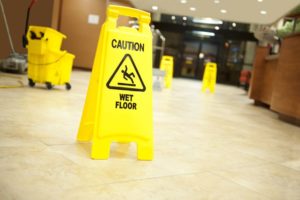
However, in a slip and fall at a commercial property in Binghamton, the key issue is not just who owns the property, but who had control over the specific area where the accident occurred.
That distinction becomes especially important in commercial settings where multiple parties may share responsibility.
Landlord vs. Tenant Responsibility
One of the most common questions in commercial slip and fall cases is whether the landlord or tenant is liable. The answer often depends on the lease agreement and the specific facts of the accident.
When the Landlord May Be Responsible
Landlords are typically responsible for:
- Structural elements of the building (roof, foundation, stairwells)
- Common areas (lobbies, hallways, shared bathrooms)
- Major repairs and code compliance
- Parking lots and exterior walkways (in some cases)
If a hazardous condition exists in a common area, such as a wet lobby floor or an icy sidewalk, the landlord is often the primary responsible party.
New York law further supports this framework. Under the state’s Second Class Cities Law, municipalities like Binghamton can require adjacent property owners to maintain sidewalks and remove snow and ice. As a result, landlords often retain legal responsibility for exterior areas, even when day-to-day maintenance duties are delegated to tenants or contractors.
When the Tenant May Be Responsible
Commercial tenants (such as retail stores or restaurants) are usually responsible for:
- Interior spaces they occupy
- Day-to-day maintenance and cleaning
- Hazards created by their employees or operations
- Customer safety within the leased premises
For example, if a grocery store fails to clean up a spill, the tenant, not the landlord, may be liable.
What Happens When a Lease Assigns Responsibilities?
Commercial leases often include detailed provisions that divide responsibility between landlord and tenant. These clauses can significantly impact a commercial property slip and fall case in Binghamton and may include:
Snow and Ice Removal
A common issue in Binghamton involves snow and ice. Many commercial leases assign snow removal duties to tenants.
- If the lease clearly states the tenant is responsible and they fail to remove ice, the tenant may be liable.
- However, landlords may still be responsible if they retained control over the area or hired a contractor.
Maintenance Obligations
Leases may also specify:
- Who handles repairs
- Who inspects the property
- Who maintains safety systems
Even if a lease assigns responsibility to one party, liability may still be shared if both parties were negligent.

“Since 1959, we have secured over $1 billion in compensation for our clients. When someone is seriously injured, they’re up against insurance companies with unlimited resources. My job is to level that playing field, and fight until they get the justice they deserve.”
Daniel W. Munley

The Role of Property Management Companies
In many commercial properties, landlords hire property management companies to handle maintenance and operations.
These companies may be responsible for:
- Routine inspections
- Coordinating repairs
- Hiring maintenance staff
- Addressing hazards
If a property management company fails to fix a known dangerous condition, or should have discovered it, they can be held liable alongside the landlord.
This adds another layer of complexity to slip and fall Binghamton commercial property claims, as multiple defendants may be involved.
Liability and Maintenance Contracts
Beyond landlords and tenants, third-party contractors often play a role in commercial property upkeep.
Examples of Maintenance Contractors
- Snow removal companies
- Cleaning services
- Elevator maintenance providers
- Security companies
If a contractor performs negligent work, such as failing to salt a walkway or improperly maintaining a freight elevator, they may be directly responsible for injuries.
In some cases, both the contractor and the property owner may share liability, particularly if the owner failed to properly supervise or enforce the contract.
Building Code Violations and ADA Compliance
Commercial properties must comply with strict building codes and accessibility laws, and violations can significantly affect liability in a slip and fall case.
Common Code Violations
- Uneven flooring or loose tiles
- Improper stair design or missing handrails
- Inadequate lighting in hallways or parking areas
- Blocked or unsafe exits
ADA Compliance Issues
Failure to comply with accessibility standards can also create hazardous conditions, such as:
- Improper ramps
- Lack of handrails
- Slippery or uneven accessible routes
If a violation contributed to a fall, it can be strong evidence of negligence in a commercial property slip and fall case.
Commercial-Specific Hazards That Cause Slip and Falls
Commercial properties present unique risks that don’t typically arise in residential settings. These include:
Loading Dock Hazards
Loading docks are high-risk areas where:
- Liquids or debris may accumulate
- Height differences create tripping hazards
- Poor lighting increases danger
Responsibility may fall on the business operating the dock, the landlord, or both.
Freight Elevators and Service Areas
Unlike passenger elevators, freight elevators may:
- Lack proper safety features
- Have uneven entry points
- Be poorly maintained
If maintenance is outsourced, liability may extend to contractors.
Multi-Tenant Common Areas
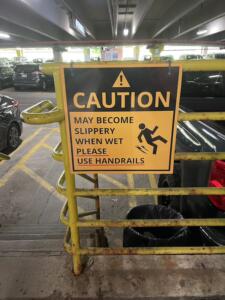 Shopping centers and office complexes often include shared spaces such as:
- Parking lots
- Sidewalks
- Food courts
- Restrooms
Responsibility for these areas is usually defined in lease agreements, but landlords often retain primary control.
Pedestrian Areas
Local ordinances also prohibit businesses from creating hazardous conditions in pedestrian areas. Binghamton’s streets and sidewalks regulations, for example, restrict obstructions, improper drainage, and unsafe structures that could endanger foot traffic. Violations of these rules can be used as evidence that a commercial property owner or tenant failed to maintain a safe environment.
Customers vs. Non-Customers: How Status Affects Liability
New York law distinguishes between different types of visitors when determining liability:
Customers (Invitees)
Customers entering a store are considered invitees, meaning:
- They are owed the highest duty of care
- Property owners must actively inspect for hazards
- Businesses must promptly address dangerous conditions
If you slip inside a store, the business must show it took reasonable steps to prevent the hazard.
Non-Customers (e.g., Cutting Through a Parking Lot)
Someone walking through a commercial parking lot without entering the business may still be owed a duty of care, but the circumstances differ.
Key considerations include:
- Whether the property was open to the public
- Whether the hazard was foreseeable
- Whether the property owner maintained the area
Even if you weren’t a customer, you may still have a valid claim in a slip and fall commercial property case in Binghamton.
If your slip and fall occurred on a university campus rather than a privately owned commercial property, the process is significantly different; public institutions like Binghamton University require you to act within 90 days.
Actual vs. Constructive Notice in Slip and Fall Cases
To hold a party liable, you generally must show they had notice of the hazardous condition.
Types of Notice
- Actual notice: The owner knew about the hazard
- Constructive notice: The hazard existed long enough that they should have known
For example:
- A spill left unattended for hours may establish constructive notice
- A recently spilled drink may not
In commercial settings, businesses are expected to conduct regular inspections, making it easier to establish constructive notice.
Why Are Commercial Slip and Fall Cases More Complex?
A Binghamton commercial property slip and fall case is typically more complex than a residential claim because it involves:
- Detailed lease agreements
- Multiple layers of responsibility
- Corporate defendants and insurance carriers
- Maintenance and service contracts
- Regulatory compliance issues
These factors require a thorough investigation to identify all liable parties and build a strong claim.
Shared Liability in Commercial Slip and Fall Cases
Unlike residential accidents, commercial slip and fall claims often involve multiple responsible parties.
For example:
- A landlord may own the building
- A tenant may operate the business
- A property manager may oversee maintenance
- A contractor may handle snow removal
Each party’s role is examined to determine how liability is divided.
New York follows a comparative negligence system, meaning:
- Multiple parties can share fault
- Your compensation may be reduced if you are partially responsible
How Long Do You Have to File a Slip and Fall Claim in Binghamton?
Under New York law, you generally have three years from the date of your accident to file a personal injury lawsuit against a private commercial property owner, landlord, or contractor. That deadline changes significantly if a government entity is involved, or if a city-maintained sidewalk or municipal property contributed to your fall. A Notice of Claim may be required within 90 days. Understanding which deadline applies to your specific situation is critical to protecting your right to compensation. Learn more about Notice of Claim requirements in Binghamton.
What to Do After a Slip and Fall on Commercial Property
If you’re injured in a commercial setting in Binghamton, taking the right steps can protect your claim:
- Report the incident to the business or property manager
- Document the scene with photos or video
- Get contact information from witnesses
- Seek medical attention promptly
- Avoid giving detailed statements to insurers without legal advice
These actions can help preserve evidence and strengthen your case.
Talk to a Lawyer About Your Slip and Fall on a Commercial Property in Binghamton
If you’ve been injured in a slip and fall on a commercial property in Binghamton, you may be entitled to compensation, but identifying who is responsible is the first and most important step.
Munley Law has nearly seven decades of experience handling complex premises liability and slip and fall cases, including those involving commercial properties in Binghamton. Our nationally recognized team focuses on identifying all responsible parties and pursuing full compensation for injured clients.
Contact us today to book a free consultation, protect your rights, and ensure you receive the compensation you deserve.
Daniel W. Munley
Daniel W. Munley is an award-winning personal-injury attorney and champion of plaintiffs’ rights. For decades he’s won multi-million verdicts and settlements and is recognized as a national leader in truck and rideshare litigation, including a record $26 million truck settlement in Northeastern Pennsylvania and a $20 million recovery in 2024 for life-altering commercial-vehicle injuries.