




When a commercial truck’s tire blows, the next few seconds are incredibly dangerous for any vehicles nearby. Tire blowout truck accidents can cause drivers to lose control, jackknife, swerve across multiple lanes, or collide with nearby vehicles, often resulting in severe injuries and multi-vehicle crashes.
What most victims do not realize is that the majority of these blowouts were entirely preventable. Many are the result of worn tires left in service too long, pressure checks skipped, maintenance logs falsified, and overloaded trailers dispatched anyway.
Understanding how these crashes occur and who is responsible is the first step toward recovering the maximum compensation for tire blowout injuries. At Munley Law, our board-certified truck accident attorneys will protect your rights and hold the responsible parties accountable. Call today for a free consultation.
Contact a Truck Accident Lawyer at Munley Law
 Call Us At 844-686-5397
 Why Truck Tire Blowouts Are So Dangerous
A fully loaded commercial truck can weigh up to 80,000 pounds, which is roughly 20 times the weight of an average passenger vehicle. When a tire fails at highway speed, physics responds immediately and violently.
According to the Federal Motor Carrier Safety Administration (FMCSA), tires and brake systems were the most common vehicle-related issues contributing to fatal large truck crashes. 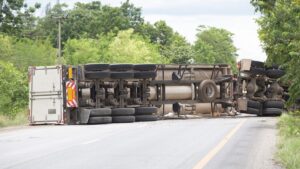
Truck tire blowouts create two distinct categories of danger.
The first is the immediate loss of vehicle control. A steer tire blowout is when one of the tires in the front of the truck, near the steering wheel, blows out. When this happens, it yanks the tractor sharply toward the blown side.
A rear-drive or trailer tire failure shifts traction unevenly, creating the conditions for a jackknife or rollover in seconds. Either scenario sends tens of thousands of pounds of trucks into adjacent lanes with almost no warning for surrounding drivers.
The second hazard is tire debris or what truckers call “road gators.” When a large commercial tire blows, it does not simply go flat. It shreds. Chunks of tread and sidewall rubber scatter across the roadway at highway speed. A piece of debris striking a windshield or going under a vehicle at 70 miles per hour can cause a serious secondary crash.
These two hazards explain why tire blowout truck accidents so often result in multi-vehicle pileups and why nearby passenger vehicle occupants almost always suffer the worst injuries.
What Causes Truck Tire Blowouts?
Truck tires are built tough, but they are not invincible. When the people responsible for maintaining them cut corners, failure becomes a matter of when, not if.
Underinflation
This is the leading cause of commercial truck tire failure. An underinflated tire flexes more with every rotation, generating heat inside the sidewall.
Over time, that heat degrades the tire’s internal structure until it fails, often suddenly, and without any warning.
Federal regulations require regular pressure checks, but those checks are frequently skipped under schedule pressure.
Worn or Bald Tires
Federal law under 49 CFR § 393.75 sets minimum tread depth requirements for commercial tires: 4/32 of an inch for steering axle tires and 2/32 of an inch for all others. Tires worn below these minimums are prohibited from road use.
When an under-tread tire blows out and causes a crash, that federal violation becomes “negligence per se,” which means the violation itself is proof of fault.
Overloading
Every commercial tire has a rated load capacity. When a truck is loaded beyond that limit, or when weight is distributed unevenly across axles, excess pressure accelerates tire degradation. Overloading is especially dangerous on rear drive axles. When a truck was overweight at the time of a blowout, both the carrier and the cargo shipper may share liability.
Retreaded Tire Failure
Many carriers use retreaded tires on trailer axles to reduce costs. When retreads are properly applied, they can be safe.
When they are not, or when applied to tires past their service life, they can separate from the tire body at highway speed, creating some of the most dangerous road debris imaginable.
Manufacturing Defects
Sometimes the tire itself is the problem. A design flaw or production error can cause premature failure even when a tire appears to be in good condition and has been properly maintained. In those cases, the tire manufacturer may be liable under a product liability theory.
Who Is Liable in a Truck Tire Blowout Accident?
Unlike a standard car accident, a truck tire blowout case often involves multiple responsible parties. Identifying all of them is essential to recovering full compensation:
- The Truck Driver: Federal law requires drivers to conduct pre- and post-trip inspections that include tires before and after every drive. If a driver skipped those checks, ignored visible damage, or failed to report a known problem, they can be held personally liable for the resulting crash.
- The Trucking Company: The carrier is responsible for maintaining its fleet in a safe operating condition. They must keep maintenance records, replace tires on schedule, and avoid dispatching a truck it knows is unsafe. Even when driver negligence is involved, the company can also be held liable under the legal doctrine of respondeat superior, which holds employers accountable for employees’ on-the-job actions.
- Third-Party Maintenance Providers: When carriers outsource tire maintenance to outside shops, those shops take on a duty of care. If an outside mechanic inspected the tires, missed obvious defects, and signed off on the truck as roadworthy, they may share liability. This is particularly true when records show the defect was detectable.
- The Tire Manufacturer: If the tire itself was defective in design or manufacturing, the maker can be named as a defendant under a product liability claim. These cases do not require proving maintenance negligence. They must only prove that the product itself was defective and caused the crash.
- Government Entities: If a pothole, road debris, or poorly maintained pavement caused or contributed to the blowout, the responsible government agency may bear partial liability. Claims against government entities follow different procedures and often have shorter deadlines, which is another reason to contact an attorney immediately.
What Injuries are Common in Truck Tire Blowout Accidents?
Because blowouts produce specific crash patterns such as rollovers, jackknifes, debris strikes, and sudden multi-vehicle collisions, the injuries that follow tend to be severe: 
- Traumatic brain injuries (TBI) from the violent impact forces of rollovers and jackknife crashes.
- Spinal cord injuries and paralysis, particularly in side-impact and underride scenarios.
- Crush injuries when a rolling or tipping truck strikes or lands on a passenger vehicle.
- Lacerations and puncture wounds from road gator debris penetrating windshields or entering vehicles.
- Broken bones and internal injuries common across all truck crash types.
- Wrongful death. Blowout crashes are among the most fatal on the highway; nearby passenger vehicle occupants bear the greatest risk
The severity of these injuries is why it is essential to seek both medical attention and legal counsel as quickly as possible after a blowout crash.
What Evidence is Important in a Truck Tire Blowout Case?
These cases demand a different investigation than a standard car accident claim. The most critical evidence is highly specific, and much of it disappears within days without prompt action.
- The tire itself: the physical carcass must be recovered immediately. Tire engineers can determine the exact failure mode from the remains.
- Maintenance and inspection records: federal law mandates detailed logs. Gaps, missing entries, or falsified records are powerful evidence of negligence.
- Pre- and post-trip inspection reports: required by law before and after every trip; they reveal whether the driver checked the tires and reported any problems.
- Black box / ECM data: records speed, braking, and load data from the moments before the crash. Often overwritten within days.
- Driver qualification file: training and inspection compliance history that may reveal a pattern of neglect.
- Weigh-station records: confirm whether the truck was operating above its legal weight limit.
- Spoliation letter: sent by your attorney immediately after the crash, demanding that the trucking company preserve all relevant evidence. Without it, critical records may be legally destroyed.
Munley Law has three attorneys board-certified in truck accident law by the National Board of Trial Advocacy. We are among the few firms in the country with that designation. Our expert truck accident lawyers know exactly which records to demand, how to read them, and how to build a case that holds every responsible party fully accountable.
What to Do After a Truck Tire Blowout Accident
The actions you take in the first hours after a blowout crash can significantly affect the strength of your claim. Here’s what you should do after an accident:
- Call 911 and get medical attention immediately, even if you feel okay. Serious injuries like TBI and internal bleeding are often not immediately apparent.
- Document the scene with photos. Take pictures of the truck, the blown tire, all road debris, every vehicle involved, and your injuries before anything is moved.
- Collect witness names and contact information. Eyewitness testimony can be decisive.
- Do not speak to the trucking company’s insurance adjuster with a lawyer. The trucking company’s insurance will contact you fast, and anything you say can be used to minimize your claim.
- Contact a truck accident attorney as soon as possible. ECM data can be overwritten within days, and the trucking company’s legal team is already working from the moment of the crash.
Frequently Asked Questions About Tire Blowout Truck Accidents
Is a Truck Tire Blowout Always Someone’s Fault?
In most cases, yes. Commercial trucks are subject to strict federal inspection and maintenance requirements precisely because tire failures are so dangerous. When a blowout occurs, there is nearly always an identifiable cause, such as underinflation, worn tread, overloading, a maintenance failure, or a manufacturing defect. Someone is responsible for that cause. A true unavoidable accident is the exception, not the rule.
Can I Sue The Trucking Company If a Tire Blowout Caused My Accident?
Yes, in most cases. If the trucking company failed to maintain the tires, ignored driver reports of a tire problem, or dispatched a truck that should have been taken out of service, they can be held liable. And even if the driver bears primary fault, the company can be held responsible for the driver’s actions under the doctrine of respondeat superior.
What Compensation Can I Recover After A Truck Tire Blowout Accident?
Victims typically recover two categories of damages.
Economic damages cover measurable losses: medical bills, lost wages, diminished earning capacity, property damage, and injury-related household expenses.
Non-economic damages cover intangible losses: pain and suffering, emotional distress, loss of enjoyment of life, and loss of consortium. In fatal cases, surviving family members may also pursue a wrongful death claim covering funeral costs, lost financial support, and loss of companionship.
Do I Need a Truck Accident Specialist, or Will Any Personal Injury Attorney Do?
Truck tire blowout cases involve federal FMCSA regulations, complex multi-party liability, highly technical tire failure evidence, and corporate defendants backed by experienced insurance teams. A generalist attorney who rarely handles commercial truck cases may not know which records to request or how to go up against a trucking company’s defense. In truck accident law, specialization directly affects outcomes.
Contact a Truck Tire Blowout Accident Attorney at Munley Law
Tire blowout truck accidents move fast, and so does the evidence. The trucking company’s insurer is working on your case from the moment of the crash. You need someone equally prepared in your corner.
Munley Law’s board-certified, award-winning lawyers know which evidence matters, which parties are responsible, and how to fight for full compensation.
Our lawyers work on a contingency fee basis, which means you don’t pay a dime unless we win your case. Contact us for a free consultation with an expert truck accident lawyer today.

Daniel W. Munley
Daniel W. Munley is a nationally recognized, leading truck accident lawyer. He has been board certified in Truck Accident Law by the NBTA as well as being a charter member for the American Association for Justice Trucking Litigation Group. Daniel often takes part in speaking engagements presenting the latest cutting-edge technology and trial techniques to help attorneys nationwide protect the rights of truck accident victims. Additionally, Daniel has secured numerous multi-million dollar settlements for victims, including the largest truck accident settlement for an individual plaintiff on record in Northern Pennsylvania, at $26 million.