Who Is Responsible If You’re Hurt at Mohegan Arena at Casey Plaza?
Under Pennsylvania law, an injury at a venue like Mohegan Arena at Casey Plaza in Wilkes-Barre Township falls into one of two very different categories. A risk inherent in the event itself, such as a puck clearing the glass at a hockey game, is usually treated as the spectator’s own risk. Almost everything else, such as a fall in a crowded concourse, a slick restroom floor, or an injury in the parking lot off Highland Park Boulevard, is the venue’s responsibility, because the operator owes its guests a high duty of care.
Knowing which side of that line your injury falls on is what decides whether you have a claim. If you were injured at Mohegan Arena at Casey Plaza, our Wilkes-Barre personal injury attorneys can help. Contact Munley Law for a free consultation.
What Injuries Does the Arena Have to Answer For?
When you buy a ticket, you become what the law calls a business invitee, and the operator of a venue like Mohegan Arena owes you the highest duty of care a property owner can owe in Pennsylvania. This means keeping the concourses, stairs, restrooms, seating, and parking areas reasonably safe, fixing hazards, and warning guests about dangers that cannot be fixed right away. 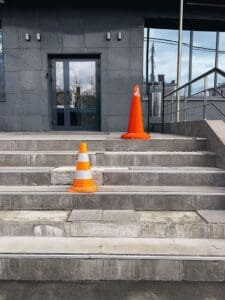
A drink spilled and left on a concourse floor during a sold-out concert, a broken seat, an unlit stairwell, or a cracked curb in the lot off Highland Park Boulevard are the kinds of conditions the venue has to address.
The key question in most of these cases is notice. Did the venue know about the hazard, or should it have known, and did it have a reasonable chance to fix it? A drink spilled seconds before you slip may not be enough to win a claim. However, a spill left on a busy concourse for an hour usually is. The gap between a hazard that appeared moments ago and one that sat ignored is the heart of a premises liability case.
What Does Pennsylvania’s No-Duty Rule Mean for Sports Fans?
It means the venue is generally not liable for injuries arising from a normal, expected part of the event itself. Pennsylvania courts call this the no-duty rule, and it has applied to spectator sports for decades.
A puck that flies over the glass during a Wilkes-Barre/Scranton Penguins game, like a foul ball at a baseball game, is treated as a risk a fan accepts by attending. The trade-off is that the venue must provide protected seating where the danger is greatest, the glass and netting around the rink being the clearest example. As long as that protection is in place, an injury from a puck during the run of play is usually not something the arena has to answer for.
Pennsylvania appellate courts have applied this same reasoning to hockey, treating a puck strike during play as part of attending the sport rather than a failure by the venue.
When Does the No-Duty Rule Not Protect the Venue?
When the injury has nothing to do with the action on the ice or the stage. A wet floor at a concession stand, a fall on a poorly maintained staircase, an escalator that malfunctions, a crowd surge due to poor or inadequate crowd control, or an assault that better security could have prevented are not inherent risks of watching a game or a show. The no-duty rule does not cover them, and ordinary premises liability does.
This is important at a venue like Mohegan Arena, which hosts far more than hockey. Summer concerts, family shows like Disney on Ice, Monster Jam, graduations, and expos pack the concourses and lots with people who never expected the danger to come from a slick floor rather than the event they paid to see.
The seasons change the hazards, too. Summer crowds bring spills and heat, and northeastern Pennsylvania winters bring snow and ice tracked in from the lots that can turn entrances and concourses slick. None of that is a risk of the show. All of it is the venue’s to manage.
Who Can Be Held Responsible Besides the Arena?
Often, more than one party can be held responsible. The venue operator is the obvious one, but a separate company that runs the concessions, a security contractor, a cleaning service, or the promoter behind a specific event can share responsibility, depending on who controlled the area and who created or ignored the hazard.
Determining who was in charge of the spot where you were hurt is one of the first steps in a Luzerne County venue case, and it matters because each party may carry separate insurance. A venue will often point at a contractor while the contractor points back, and identifying everyone responsible early keeps that finger-pointing from leaving you with no one to recover from.

Pennsylvania also follows a comparative negligence rule, so even if you were partly at fault, for example, walking through a clearly marked closed area, you can still recover as long as you were less than fully responsible. Your recovery is reduced by your share of the blame.
What Should You Do If You’re Injured at the Arena?
Report your injury to venue staff, ensure an incident report is created before you leave, and ask how to obtain a copy. Get the names and numbers of anyone who saw what happened, photograph the hazard and the area around it while it is still there, and keep your ticket as proof you were a paying guest.
Be careful about giving the venue’s insurer a recorded statement before you understand the claim, because early, casual answers about how a fall happened can be turned into an argument that you were the one not paying attention.
See a doctor promptly. The gap between an injury and treatment is one of the first things an insurer will use to question a claim. Acting quickly is important for the case, too. Pennsylvania generally gives you two years to file a personal injury lawsuit, and the evidence at a busy venue disappears fast, video gets recorded over, and the scene is cleaned within minutes.
A case that does move forward may be filed in the Luzerne County Court of Common Pleas, and the incident report and the photos you took that night are often the difference between proving a hazard existed and arguing about it months later.
A night out at a concert or a game is the last place anyone expects to get hurt, and the rules about who is responsible are not obvious from your seat.
The short version: if the injury resulted from the event itself, it is usually your own risk; if it resulted from the condition of the building or the lot, it is usually the venue’s.
Munley Law has represented injured people across Luzerne County and the Wyoming Valley for nearly 70 years. Contact us today for a free consultation to discuss your claim.

Marion Munley
Marion Munley has been practicing personal injury law for nearly 40 years. She is triple board-certified by the National Board of Trial Advocacy for Truck Accident Law, Civil Trial Law, and Civil Practice Advocacy. She currently serves as Vice President of the American Association for Justice, an organization dedicated to safeguarding victims’ rights. Marion has won many multimillion-dollar recoveries for her clients, including one of the largest trucking accident settlements in history. She has been named a Top 10 Super Lawyer in Pennsylvania since 2023, a Best Lawyer in America, and was recently inducted to the Lawdragon Hall of Fame.
 Call us at (844) 686-5397
 Posted in Personal Injury.