What Is New York’s Move Over Law?
Every year, drivers across the Southern Tier pass cars stopped on the shoulder of I-81 or Route 17 without slowing down or changing lanes. Some of those encounters turn deadly. New York’s Move Over Law exists to prevent those tragedies, and a major expansion took effect in 2024 that every driver on Binghamton’s highways needs to understand.
The law has long covered emergency vehicles with flashing lights. What changed is the scope. As of March 27, 2024, the requirement now extends to ordinary passenger cars stopped on the shoulder as well. If you or a loved one was struck by a driver who failed to move over or slow down, contact the Binghamton car accident lawyers at Munley Law right away.
What Is New York’s Move Over Law?
New York’s Move Over Law is codified in Vehicle and Traffic Law § 1144-a. First enacted in 2010 as the Ambrose-Searles Move Over Act, named for a state trooper and a sheriff’s deputy killed in roadside collisions, the law originally required drivers to change lanes or slow down when approaching stopped emergency vehicles. The legislature later extended those protections to tow trucks and other hazard vehicles displaying amber lights.
The requirement is clear: when approaching a stopped vehicle covered by the law, a driver must move one full lane away from the shoulder if it is safe to do so. If a lane change is not safely possible, the driver must reduce speed to a reasonable level while passing. Violating this is a moving infraction that carries fines and points on your license.
Does New York’s Move Over Law Cover Stopped Passenger Vehicles?
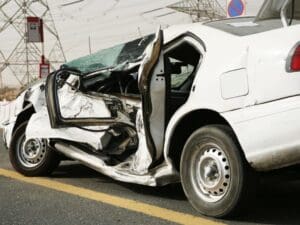 As of March 27, 2024, the law covers all vehicles stopped or disabled on the shoulder of a parkway or controlled-access highway, including ordinary passenger cars. Governor Kathy Hochul signed the legislation in October 2023, and it took effect with no grace period.
The expansion added VTL § 1144-a(d), which requires drivers to exercise due care when approaching any vehicle parked, stopped, or standing on the shoulder, regardless of whether that vehicle is displaying emergency lights. A driver who sees a disabled car on the shoulder of Route 17 outside Binghamton is now legally required to change lanes or slow to a safe speed. The law covers:
- Disabled or broken-down passenger cars
- Vehicles involved in accidents stopped on the shoulder
- Emergency vehicles with red, blue, or white flashing lights
- Tow trucks and hazard vehicles displaying amber lights
- Highway maintenance, construction, and sanitation vehicles
The Danger of Roadside Car Crashes in Broome County
According to the New York State Governor’s office, 37 people were killed outside of disabled vehicles in New York between 2016 and 2020. Nationally, nearly 300 drivers are struck and killed on the roadside every year, according to the National Highway Traffic Safety Administration.
I-81 and Route 17 through Broome County carry heavy commercial truck traffic. When a car stops on those shoulders, the speed difference between a standing motorist and passing trucks is severe. A driver who fails to move over, even briefly, can cause traumatic brain injury, spinal cord damage, or broken bones.
When a driver violates VTL § 1144-a and injures someone, that violation is strong evidence of negligence. New York courts have recognized that failure to comply with a traffic safety statute can establish breach of duty, one of the elements a plaintiff must prove to win a negligence case.
Penalties for Violating New York’s Move Over Law
The New York State Police actively enforces this law. Drivers who fail to move over or slow down face:
- A fine of up to $150 for a first offense, plus a $93 surcharge
- Two points added to their New York driver’s license
- A fine of up to $300 for a second offense within 18 months
- A fine of up to $450 for a third offense within 18 months
- Potential license suspension for accumulating 11 points within 18 months
Beyond those penalties, a driver who causes injury by violating the Move Over Law may face civil liability for the full damages suffered, including medical bills, lost income, and pain and suffering.
What to Do If You Were Struck by a Driver Who Didn’t Move Over
If a driver struck you or your vehicle while you were stopped on a highway shoulder, what you do in the hours after matters for your claim.
- Call 911 and get a police report. The officer will document the scene, including whether the at-fault driver was in the proper lane. That report is evidence.
- Get medical care right away, even if you feel fine. Adrenaline masks pain, and waiting gives insurers a reason to argue your injuries weren’t serious.
- Document the scene before you leave. Photos of your vehicle’s position, the other driver’s lane, skid marks, and shoulder markings are harder to reconstruct later.
- Don’t give a recorded statement to the other driver’s insurance company before talking to an attorney. They will use it to minimize your claim.
A violation of VTL § 1144-a is strong evidence that the other driver was negligent. The sooner that evidence is preserved, the stronger your case.
Contact Our Binghamton Personal Injury Lawyers for a Free Consultation
If you were injured by a driver who failed to move over or slow down on a Binghamton-area highway, contact Munley Law. Our attorneys know New York’s Move Over Law and know how to build a case under VTL § 1144-a. In New York, injury victims generally have three years to file a personal injury claim, so the sooner you get legal advice, the better.
We serve clients throughout Binghamton, Broome County, the Southern Tier, and surrounding communities in New York. Call us to schedule a free consultation.
Posted in Car Accidents.