Why Route 309 Is One of Luzerne County’s Most Dangerous Stretches for Truck Accidents
Anyone who drives between Wilkes-Barre and Mountain Top knows the climb well. Route 309 rises out of the Wyoming Valley in a long, steep grade. Every day, hundreds of tractor-trailers make that climb and descent, serving the Crestwood Industrial Park and the warehouse corridor that has grown up around I-81.
For commuters who share this road, the math is uncomfortable as the risks are high. A loaded tractor-trailer can weigh 80,000 pounds, and the descent into the valley is exactly the kind of grade where truck brakes fail. Crashes on this stretch are not random; they tend to follow patterns, and these patterns usually point to decisions made long before the truck started down the mountain.
What Makes the Mountain Section on Route 309 So Dangerous?
The danger of Route 309 starts with geography. The grade between Mountain Top and the valley floor is long and steady, which is harder on truck brakes than a short, steep hill. A driver who rides the brakes instead of downshifting builds heat in the drums with every mile. Overheated brakes gradually lose stopping power, then suddenly lose it completely. By the time a driver feels the pedal go soft, the truck is already committed to the descent. 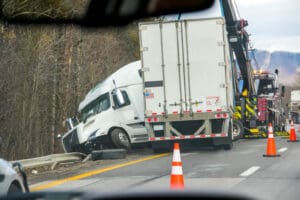
Traffic volume compounds the problem. Luzerne County has become one of the busiest warehousing and distribution regions in Pennsylvania, and Crestwood Industrial Park in Mountain Top sits at the top of the grade. This results in a steady flow of loaded trailers moving downhill toward Wilkes-Barre, mixing with local commuters at the bottom where the highway meets valley traffic.
Then there is the weather. The mountain section sits high enough that it ices before the valley does, and fog settles on the upper grade on mornings when the valley is clear. A driver dispatched from out of the area has no way to know unless someone tells them, and freight schedules rarely allow time for caution.
Brake Failure Is Usually a Maintenance Failure
When a runaway truck makes the news on the 309 descent, the first explanation offered is almost always “the brakes failed.” That phrase makes the crash sound like an act of God. It usually isn’t.
Federal Motor Carrier Safety Administration regulations require carriers to systematically inspect, repair, and maintain every commercial vehicle they operate, and drivers must complete pre-trip inspections that include the braking system. Brake problems that cause mountain-grade crashes, such as out-of-adjustment slack adjusters, worn linings, and leaking air lines, are exactly what those inspections exist to catch.
The emergency escape ramp on the descent was built because the state knows trucks lose their brakes on this grade. A truck that ends up on the ramp, or worse, crashes into traffic at the bottom, almost always has a paper trail behind it. This trial includes skipped inspections, deferred maintenance, or a driver who was never trained to descend a grade properly. Finding that paper trail is the difference between an “accident” and a case.
Who Can Be Held Liable in a Luzerne County Truck Crash?
Truck cases are rarely about just the driver. The driver may have ridden the brakes, but the carrier chose how to maintain the truck, train the driver, and schedule the route. If a third-party shop handled the brake work, its mechanics may share responsibility. If a broker hired a carrier with a poor safety record to haul the load cheaply, the broker’s decision-making process may come into play. Even the shipper’s loading practices are important, because an overloaded or badly balanced trailer changes how a truck handles on a grade.
Scheduling pressure deserves its own mention. The distribution centers that feed this corridor run on tight delivery windows, and a driver running behind schedule has every incentive to take the descent faster than conditions allow. Federal hours-of-service rules cap how long a driver can be behind the wheel, and the truck’s electronic logging device records whether those limits were honored. A fatigued or hurried driver is a carrier problem, not just a driver problem, because the carrier sets the schedule.
Pennsylvania law allows an injured person to pursue every party whose negligence contributed to the crash, and in serious cases, that matters, because a driver’s insurance alone rarely covers a catastrophic injury. Sorting out those layers of responsibility requires getting to the evidence before it disappears.
The Evidence That Decides These Cases 
Modern tractor-trailers record their own story. The engine’s electronic control module captures speed, braking, and throttle data in the moments before a collision. Carrier records show inspection histories, driver qualification files, and hours-of-service logs. None of this evidence is permanent. Carriers are only required to keep certain records for months, not years, and a truck that gets repaired and put back in service takes its physical evidence with it.
For this reason, the first weeks after a serious truck crash are crucial. A spoliation letter forces the carrier to preserve the truck and its records. Photographs of the scene, witness names, and the responding officer’s crash report from the Wright Township, Hanover Township, or Pennsylvania State Police, all become harder to obtain as time passes. Cases filed in the Luzerne County Court of Common Pleas are won or lost on what was preserved in those early weeks.
What to Do After a Crash on the Mountain
Get medical care first, even if you feel mostly fine. Crash injuries, especially head and spine injuries, often surface days later, and a record from Wilkes-Barre General Hospital or Geisinger Wyoming Valley created on the day of the crash connects your injuries to the collision. Photograph the vehicles and the roadway if you can do so safely. Do not give a recorded statement to the trucking company’s insurer, which may contact you within days, before you understand your rights.
One point of Pennsylvania law surprises many Wyoming Valley drivers. Even if you chose limited tort on your own auto policy to save on premiums, the limited tort restriction generally does not bar full recovery when your injuries are serious, and exceptions can apply in commercial vehicle cases. Do not assume your policy choice closes the door. And keep in mind that Pennsylvania’s statute of limitations for injury claims is two years as of 2026, but the evidence that proves a truck case can vanish far sooner than that.
The 309 grade is not going to get flatter, and the warehouse traffic is not going away. What protects Wyoming Valley drivers is accountability when a carrier cuts corners. Munley Law, home to three of Pennsylvania’s four board-certified truck accident lawyers, has held trucking companies accountable for crashes across Luzerne County for more than 65 years.

Daniel W. Munley
Daniel W. Munley is a nationally recognized, leading truck accident lawyer. He has been board certified in Truck Accident Law by the NBTA as well as being a charter member for the American Association for Justice Trucking Litigation Group. Daniel often takes part in speaking engagements presenting the latest cutting-edge technology and trial techniques to help attorneys nationwide protect the rights of truck accident victims. Additionally, Daniel has secured numerous multi-million dollar settlements for victims, including the largest truck accident settlement for an individual plaintiff on record in Northern Pennsylvania, at $26 million.
 Call us at (844) 686-5397
 Posted in Truck Accidents.