Why Visibility Is the Hidden Danger in Most Lehigh Valley Motorcycle Accidents
Riding season is in full swing across the Lehigh Valley, and the roads that make the area so appealing for riders are busier than ever. This includes sweeping routes north toward Route 309 and the Blue Mountain foothills, as well as the faster stretches of Route 22 and I-78. But ask any rider what worries them, and the answer is rarely their own machine. It’s the driver who looks straight at them and pulls out anyway.
Most multi-vehicle motorcycle crashes come down to the driver of the car or truck not seeing the motorcycle. Understanding why this happens and what it legally means when it does is something every rider in Lehigh County should know.
The Most Common Crash Starts With “I Never Saw Him”
The classic motorcycle crash involves a car turning left across a rider’s path at an intersection. The driver waits for a gap, looks, pulls out, and the rider with the right of way has no time and nowhere to go. 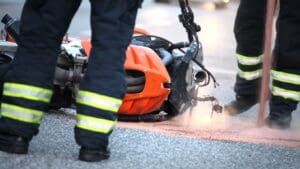
Federal crash research, dating back to the landmark Hurt Report, has found the same pattern for more than 40 years. In most crashes involving a motorcycle and another vehicle, the other driver violated the rider’s right of way.
The phrase that follows is so common that riders have a name for it: “I never saw the motorcycle.” It shows up in police reports, insurance statements, and depositions. Drivers say it because it is usually true. A motorcycle presents only a fraction of a car’s visual profile, and a driver scanning for car-sized objects can look directly at a bike and fail to process it.
Psychologists call it inattentional blindness. The law calls it failing to see what was there to be seen.
Where Visibility Fails in the Lehigh Valley
Some local roads stack the deck against riders. Route 22 is the obvious one. Its short on-ramps and tight merge zones give drivers little time to check mirrors, and a motorcycle sitting in the blind spot during a rushed merge simply disappears. Riding west on Route 22 or Tilghman Street on a summer evening adds the glare of the sun to the equation, and a low sun can erase a motorcycle’s headlight entirely.
MacArthur Road through Whitehall is a different kind of hazard. The retail strip generates constant left turns across traffic and cars nosing out of driveways and shopping center exits, making each one a potential version of the intersection crash. Cedar Crest Boulevard and Hamilton Boulevard share the same risk at commercial driveways where fast-moving traffic meets.
And the rural roads that draw riders north and west of Allentown carry their own version of the problem: shaded curves, crests that hide oncoming bikes, and drivers on familiar roads who stop expecting to see anything at all. Visibility is not just about the rider being seen; it is about drivers who have stopped looking.
“I Didn’t See the Motorcycle” Is an Admission, Not an Excuse
When a driver says they never saw the motorcycle, it is not a defense; it is an admission of their own negligence. Every driver on a Pennsylvania road has a legal duty to look for and yield to traffic that has the right of way, and that duty includes motorcycles. A rider in a lane, with a headlight on, traveling at a lawful speed, was there to be seen. A driver who failed to see them failed the duty.
This is important because insurance companies often treat “I didn’t see him” as if it softens the driver’s fault, as if the crash were nobody’s doing. It doesn’t. If anything, it concedes the central fact that the driver turned, merged, or pulled out without confirming the way was clear.
How Insurers Turn Visibility Against Riders
Expect the visibility argument to come back around, aimed at the rider. The adjuster’s version will state that the rider wore dark gear, the bike was small, the rider must have been speeding or weaving, and that is why our driver never saw him. 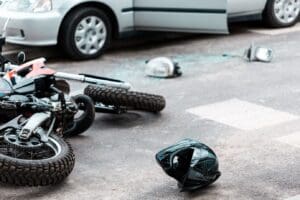
The goal is to shift a percentage of fault onto the rider because, under Pennsylvania’s comparative negligence rule, an injured person’s recovery is reduced by their share of fault. A rider found more than 50% at fault recovers nothing.
Riders should also know that Pennsylvania law permits riders 21 and over who meet experience or safety course requirements to ride without a helmet, and helmet non-use generally cannot be used to prove negligence in a civil claim.
The bigger practical point is that fault in these cases is based on evidence, not on an adjuster’s story about what riders are like. Skid marks, sightline photographs, the driver’s recorded statement, and witness accounts determine where fault actually lies.
What Lehigh Valley Riders Should Do After a Crash
Get evaluated the same day, even if you rode away. Adrenaline masks injuries, and a record from Lehigh Valley Hospital–Cedar Crest or St. Luke’s created on the day of the crash ties your injuries to the collision.
If you are physically able, photograph the scene from the driver’s vantage point, not just your own. A photo showing the clear sightline a driver had before turning is some of the strongest evidence a rider can capture. Note the sun’s position if glare played a role.
Get the names of witnesses before they drive off, and consider the possibility of cameras. Businesses lining MacArthur Road and Hamilton Boulevard record their parking lots and driveways, and that footage is routinely overwritten within days or weeks.
The responding officer’s report, whether from the Allentown Police Department or the Pennsylvania State Police, anchors the official record. And Pennsylvania’s two-year statute of limitations for injury claims, as of 2026, is the longer deadline, but camera footage and witness memories operate on a far shorter clock, so you need to act fast.
A rider who did everything right can still end up in a fight over a driver’s failure to look. The riders who win that fight are the ones whose evidence speaks louder than the adjuster’s assumptions. Munley Law has represented injured motorcyclists across the Lehigh Valley and has recovered more than $1 billion for injury victims in Pennsylvania. Contact our Allentown motorcycle accident lawyers today to schedule a free consultation.

Daniel W. Munley
Daniel W. Munley is a highly regarded and deeply caring motorcycle accident lawyer. During his accomplished career he has assisted numerous motorcycle accident victims in getting the help they need to recover, with more notable cases including a $4.3 Million Jury award for a motorcycle accident victim. Daniel has also received numerous accolades, such as being triple board certified by the National Board of Trial Advocacy and receiving a AV Preeminent Rating by Martindale-Hubbell.
 Call us at (844) 686-5397
 Posted in Motorcycle Accidents.