Why Workers’ Comp Claims Are Harder for Scranton’s Healthcare Workers
Healthcare is one of Lackawanna County’s largest employment sectors. Between Geisinger Community Medical Center, Regional Hospital of Scranton, Moses Taylor Hospital, Allied Services’ rehab facilities, and the nursing homes spread across the county, thousands of local nurses, aides, techs, and support staff spend their shifts doing physical work that takes a toll on their bodies.
When healthcare workers get hurt, they run into a workers’ comp system that is harder on them than on almost any other type of worker. The injuries healthcare workers face are genuine, yet the nature of these injuries often unfolds gradually rather than through a single traumatic event.
The slow progression of certain conditions allows insurance companies to challenge claims, as they may argue that the injuries or illnesses are not directly work-related. This makes it harder for employees to get support for their claims.
What Injuries are Common Amongst Scranton Healthcare Workers?
The classic healthcare injury is patient handling. Lifting, repositioning, transferring, and catching falling patients can strain the spine and shoulders in ways that few other jobs match. The resulting back, shoulder, and neck injuries account for a large share of hospital workers’ comp claims.
The rest of the list is just as familiar to anyone who has worked in the healthcare industry: 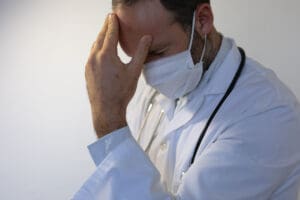
- Needlesticks and bloodborne exposures
- Slips on freshly mopped corridors
- Sharps and equipment injuries
- Repetitive strain from charting and med passes
- Injuries from combative or confused patients
Every one of these is a legitimate work injury under Pennsylvania law. However, not every one of them gets treated that way by the claims process.
Why a Back Injury Is the Hardest Workers’ Comp Claim to Prove
A roofer who falls off a ladder has a date, a time, and a witness. A nurse whose back finally gives out has a thousand small lifts spread across 15 years of shifts. Pennsylvania law covers both injuries, but insurers often dispute cumulative claims.
The standard defenses are that there was no specific incident, the MRI shows degenerative changes that come with age, and the insurance company will blame the condition on an accident that happened at home.
The counter to all of these defenses is documentation. Make sure you report the strain on the day it happens, every time, even when you finish your shift.
A worker with three documented minor back strains over two years has a record connecting the job to the injury. But a worker who toughed it out in silence has an insurer arguing that the pain is caused by old age. The medical reality may be identical; the claims outcome usually is not.
An Incident Report Is Not Automatically a Comp Claim
Hospitals run on incident reports, and healthcare workers fill them out reflexively. The trap is assuming that the form did the legal work.
What protects a workers’ comp claim is notice to your employer that you were injured on the job. While an incident report can serve as that notice, workers should explicitly inform a supervisor that they were hurt at work and follow up to confirm whether a claim was actually filed with the comp carrier.
This is critical because of who is on the other side. Large health systems are typically self-insured for workers’ comp, with claims run by third-party administrators whose job is to control claim costs for the employer. The employer and the insurer are functionally the same party, and a claim that was never formally opened is the cheapest claim there is.
As of 2026, Pennsylvania gives workers 120 days to report a work injury. However, in a cumulative-injury case, the clock questions become so complex that early reporting is the only safe option.
Violence and Exposure Injuries Are Covered, and Underclaimed
Two categories of healthcare injury go unclaimed at remarkable rates. The first is patient violence. A nurse struck by a combative patient, or hurt restraining a patient in crisis, has a compensable work injury, whether it happened in an emergency department, on a med-surg floor, or in a memory care unit. The instinct not to file because “the patient didn’t mean it” or because assaults feel like part of the job costs injured workers real benefits. The patient’s intent is irrelevant to the claim.
The second is the needlestick or exposure incident. Beyond the immediate testing and prophylaxis protocols, an exposure that leads to infection or a medically documented condition during the waiting period can support a claim. Exposure incidents should be reported and documented through both the hospital’s protocol and a comp claim, because the paper trail created in the first 24 hours is what a later claim stands on.
Why Working Through the Pain Is Problematic
Healthcare has a culture problem that insurers benefit from. Short-staffed floors, loyalty to coworkers who would absorb the load, and an ethic of putting patients first are common across healthcare environments. Workers delay reporting, keep lifting on an injured back, and seek treatment only when they can no longer work. Every week of that delay reads, in a claims file, as evidence that the injury wasn’t serious or didn’t happen at work.

The advice is unglamorous but decisive. Report every injury when it happens. Get treatment early: for the first 90 days, with a panel provider if your employer posted a proper list; after that, with any doctor you choose. Describe the job’s physical demands accurately to every provider, because “nurse” in a chart does not convey what repositioning a two-hundred-pound patient actually involves.
Don’t Overlook Income From Multiple Jobs
One more rule healthcare workers miss is that if you work a second job, agency shifts at another facility, weekend per-diem work, or a side job outside healthcare, your wage loss benefit should be calculated from your combined earnings at all jobs, not just the one where you were hurt. Pennsylvania counts concurrent employment in the average weekly wage, and a benefit check based on a single employer’s payroll shortchanges every multi-facility worker in the county.
Healthcare workers spend their careers documenting everything for everyone else. The ones who win their comp claims apply that same discipline to their own injuries.
Munley Law’s Scranton workers’ compensation attorneys, which includes a Pennsylvania Bar Association-certified workers’ compensation specialist, have represented injured workers across Lackawanna County for nearly 70 years. Contact us today to schedule a free consultation.

Caroline Munley
Caroline Munley is a certified workers’ compensation specialist. During her time fighting for the rights of workplace injury victims, she has recovered millions of dollars for injured workers, in addition to being named as among the Best Lawyers in America for Plaintiffs and Workers’ Compensation Law-Claimants for Northeastern Pennsylvania.
 Call us at (844) 686-5397
 Posted in Personal Injury.