What Is the Procedure for Investigating a Fatal Car Accident?
Losing someone in a car accident is one of the most devastating events a family can experience. In the days that follow, grief is mixed with confusion and questions that feel impossible to answer. What exactly happened? Who is responsible? What is being done to find out?
Understanding the procedure for investigating fatal car accidents can help. When a crash results in a death, the investigation that follows is more thorough, formal, and legally significant than what happens after a standard accident. It involves law enforcement, medical examiners, and often independent legal investigators. Each plays a different role in uncovering the truth.
To ensure you understand the procedure and how it may affect your family’s legal rights, we’ve explained each step of the process. For more information or any questions, contact a Munley Law car accident lawyer for a free consultation. Our compassionate lawyers are standing by to talk about your story, explain your legal options, and get to work on your case.
What Happens at the Scene of a Fatal Car Accident?
When a fatal car accident occurs, the response is immediate and more intensive than most people realize. Law enforcement arrives quickly, and patrol officers are often joined by or replaced by a specialized unit. Many police departments have a dedicated Fatal Accident Investigation Team or Traffic Homicide Investigation (THI) unit whose job is exclusively to investigate crashes that result in a fatality.
The scene itself may be closed to traffic for hours or more. This is not unusual. Investigators need time to work carefully, and disturbing the scene before evidence is collected can compromise the entire case. 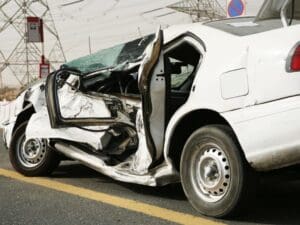
During this time, investigators will:
- Photograph and video evidence: Vehicle positions, skid marks, debris patterns, road conditions, damage to guardrails or surrounding structures, and the point of impact
- Measure skid marks and gouge marks in the pavement: These are used to calculate vehicle speed and braking behavior before the crash
- Document weather conditions, road surface, visibility, and lighting at the time of the crash
- Conduct preliminary interviews with witnesses, drivers, and passengers still at the scene
- Secure surveillance footage from nearby traffic cameras, business cameras, and traffic signals before it is overwritten (most systems record over footage within 24 to 72 hours).
The deceased is not moved until investigators have documented the scene. Every detail is treated as potential evidence.
How Police Investigate a Fatal Car Accident
Once the scene has been processed, the investigation continues, often for weeks or months. The steps that follow are more in-depth than what most people associate with a routine accident investigation.
Formal Witness Interviews
Police take formal recorded statements from everyone who saw or was involved in the crash. These statements are compared against each other and against the physical evidence. Inconsistencies between what witnesses say and what the evidence shows can be critical in determining fault.
Toxicology Testing
In a fatal crash investigation, all surviving drivers may be subject to blood draws and sobriety testing. Law enforcement can legally compel these tests when a fatality is involved. Results are used to determine whether alcohol or drugs played a role in the crash. These findings can have both criminal and civil consequences for the at-fault driver.
Cell Phone Record Subpoenas
Distracted driving is one of the leading causes of fatal car accidents. As part of a fatality investigation, police can obtain a subpoena for the at-fault driver’s cell phone records. These records can show whether a driver was texting, calling, or using an app at the exact moment of impact. This evidence is often central to a wrongful death claim.
Vehicle Inspection
Investigators examine the mechanical condition of every vehicle involved in the crash. Brake failure, tire blowouts, steering defects, and lighting problems are documented. If a vehicle defect contributed to the crash, the manufacturer or maintenance provider may share liability.
Criminal Determination
Once evidence has been gathered, investigators determine whether criminal charges are warranted. Charges can include DUI causing death, reckless driving, or vehicular homicide, even when the driver did not intend to cause harm. The criminal investigation runs parallel to any civil wrongful death case your family may pursue, and both can proceed at the same time.
What Is Accident Reconstruction and Why Does It Matter?
Accident reconstruction is the scientific process of determining exactly how and why a crash occurred. It uses physical evidence, vehicle data, and engineering analysis to answer questions that eyewitness accounts alone cannot.
Reconstruction experts, who may work for law enforcement or be hired independently by attorneys, analyze:
- Skid marks, gouge marks, and debris fields to determine vehicle speed and direction of travel before impact
- Vehicle crush and deformation patterns to identify the point of impact and the force involved. The Event Data Recorder (EDR) records speed, braking, throttle input, and seatbelt status in the seconds before the crash
- Airbag deployment data, which confirms the timing and severity of impact
- Final vehicle rest positions and their relationship to the point of impact
For a grieving family, accident reconstruction can be the difference between suspicion and proof. It can establish that the other driver was traveling well above the speed limit, brakes were never applied, or that a vehicle defect caused the crash, all of which are central to a wrongful death claim.
An attorney can hire an independent reconstruction expert to challenge findings that do not reflect what the evidence actually shows.
The Role of the Medical Examiner in a Fatal Car Accident Case
When someone dies in a car accident, the medical examiner, or coroner, conducts a separate official investigation into the cause and manner of death. This process runs alongside the law enforcement investigation, and its findings are equally important to a wrongful death case.
The Autopsy
An autopsy determines the exact cause of death and distinguishes between injuries caused by the crash itself versus any pre-existing conditions. In a wrongful death claim, the defense may argue that a victim had a health condition that contributed to the outcome.
An autopsy report that clearly links the fatal injuries to the crash is one of the strongest pieces of evidence a family’s attorney can have.
The Toxicology Report
The medical examiner also conducts toxicology testing on the deceased. These results can work both ways. They may show that the deceased was sober and fully alert at the time of the crash, which is important if the at-fault driver’s insurance company tries to shift blame. Or, in cases involving DUI drivers, the toxicology report on the at-fault party becomes a central piece of evidence.
The Death Certificate
The medical examiner issues the official death certificate, which records the cause and manner of death. This document is required to open a wrongful death claim in Pennsylvania and to access many of the legal remedies available to surviving family members. Families should request certified copies as soon as they are available.
How Long Does a Fatal Car Accident Investigation Take?
This is one of the most common questions families ask, and the answer depends on the case’s complexity. 
- Simple single-vehicle crashes with clear liability can be resolved in a matter of weeks.
- Multi-vehicle crashes, disputed-fault crashes, or cases involving suspected criminal conduct typically take several months.
- DUI investigations, cases awaiting toxicology results, or crashes involving commercial vehicles can take 6 months or more.
Toxicology lab results alone can take six to twelve weeks, and accident reconstruction analysis takes time. If criminal charges are filed, the criminal case may unfold over many months before any resolution.
However, it is important to know that a civil wrongful death case does not need to wait for the criminal investigation to conclude. The two processes are separate. While a criminal conviction can strengthen a civil case, it is not required. A skilled wrongful death attorney can begin building a civil case even while a criminal investigation is ongoing.
What Families Should Do to Protect Their Legal Rights
In the aftermath of a fatal car accident, families are grieving, but the legal system does not pause for grief. Insurance companies begin working their case almost immediately, evidence disappears, and deadlines approach.
Here is what you and your family should do to protect your rights:
- Request all official documents. Obtain certified copies of the police report, accident investigation report, autopsy, toxicology results, and death certificate as soon as they are available
- Preserve all evidence you have access to, including photos from the scene, any surveillance footage you know of, witness contact information, and the deceased’s medical records
- Do not give recorded statements to any insurance company before speaking with an attorney. Adjusters are trained to ask questions that can be used to minimize or deny your claim
- Act quickly on electronic evidence. Black box data and surveillance footage can be gone within 24 to 72 hours; an attorney can send a legal preservation demand immediately to prevent destruction
- Know your deadline. In Pennsylvania, wrongful death claims must generally be filed within two years of the date of death; missing that deadline means losing your right to recover compensation
Families Deserve Answers, and Munley Law Can Help You Get Them
A fatal car accident investigation can take months. The legal process that follows can take longer. But the decisions made in the first days and weeks – about evidence, about insurance adjusters, about legal representation – can shape everything that comes after.
Munley Law has the experience and resources to conduct a thorough independent investigation alongside law enforcement, and to fight for the full accountability and compensation your family deserves.
Contact Munley Law today for a free consultation. There is no fee unless we win your case.

Marion Munley
Marion Munley has been practicing personal injury law for nearly 40 years. She is triple board-certified by the National Board of Trial Advocacy for Truck Accident Law, Civil Trial Law, and Civil Practice Advocacy. She currently serves as Vice President of the American Association for Justice, an organization dedicated to safeguarding victims’ rights. Marion has won many multimillion-dollar recoveries for her clients, including one of the largest trucking accident settlements in history. She has been named a Top 10 Super Lawyer in Pennsylvania since 2023, a Best Lawyer in America, and was recently inducted to the Lawdragon Hall of Fame.
 Call us at (844) 686-5397
 Posted in Car Accidents.