




Flatbed trucks are one of the most common sights on American highways. They haul the steel beams that build our bridges, the lumber that frames our homes, and the heavy machinery that powers construction sites. Their open design is exactly what makes them so useful. It’s also what makes them so dangerous.
Unlike an enclosed semi-trailer, a flatbed has no walls, roof, or container to hold the load in place. Everything on that truck is exposed to wind, road vibration, and the physics of highway driving.
The only thing standing between thousands of pounds of cargo and the vehicles around it is a system of straps, chains, and binders. When that system fails, the results can be catastrophic.
Flatbed truck accidents are not just truck accidents. The open-deck design creates unique, severe dangers that require a specific kind of legal investigation. At Munley Law, our truck accident lawyers understand the complex regulations surrounding cargo securement, loading procedures, and commercial trucking operations. We work to hold negligent drivers, trucking companies, and cargo handlers accountable for the harm they cause.
What Makes Flatbed Truck Accidents Distinctly Dangerous?
The danger that separates a flatbed truck from every other commercial vehicle on the road comes down to one word: containment. There is none. 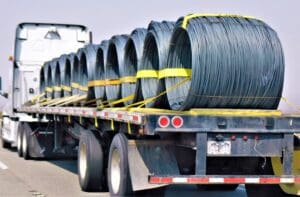
On an enclosed trailer, cargo that shifts during transit stays inside the box. On a flatbed, shifting cargo has nowhere to go but onto the road and into the path of other drivers. A strap that snaps, a chain that slips, or a binder that was never properly set can turn several tons of material into an uncontrolled highway hazard in an instant.
The cargo flatbeds carry makes this even more dangerous. Flatbeds are used to haul heavy, rigid materials with sharp edges or the ability to roll, such as steel beams, steel coils, lumber, concrete pipe, and heavy construction equipment. These are not soft goods. When they fall from a truck at highway speed, they do not simply land on the road. Instead, they strike, penetrate, and crush whatever is in their path.
Steel coils are among the most dangerous flatbed cargo of all. The federal government dedicated an entire section of its cargo securement regulations specifically to steel coils. A coil weighing several thousand pounds that breaks free from its tie-downs does not slide; it rolls.
Overhanging loads pose a hazard: material extending beyond the trailer’s frame can strike bridges, highway signs, or vehicles in adjacent lanes with no warning. And tall or unevenly stacked cargo raises the truck’s center of gravity, making rollovers far more likely during sharp turns or sudden braking.
Contact a Truck Accident Lawyer at Munley Law
 Call Us At 844-686-5397
 How Flatbed Truck Accidents Commonly Happen
Most flatbed truck accidents trace back to one of a handful of causes. These causes are all tied to the open-deck design and the cargo these trucks carry. Here are the most common causes of flatbed truck accidents:
Cargo Securement Failure
This is the leading cause of flatbed truck accidents. Federal law sets strict rules for securing cargo. The total working load limit of all tie-downs must equal at least 50 percent of the cargo’s weight, and the number required changes based on load weight and length. When carriers rush or cut corners, these rules get violated, and cargo may fall.
Worn or Damaged Tie-Down Equipment
Straps, chains, binders, and ratchets take a beating over thousands of miles of highway use. Federal rules prohibit any tie-down with knots, cracks, cuts, or corrosion that reduces its rated strength. However, damaged equipment still gets used when maintenance is skipped. A single failed strap on a load of steel or lumber can be enough to trigger a catastrophic crash.
Improper Loading by a Third Party
On many flatbed hauls, the driver does not load the truck. A shipper, warehouse crew, or loading dock team secures the cargo before the driver arrives. If that crew stacks cargo incorrectly, uses the wrong tie-down points, or distributes weight unevenly across the deck, the load may be dangerously unstable before the truck ever leaves the facility.
Tarp Failure
Many flatbed loads are covered with heavy tarps to protect cargo from the weather. A tarp that is improperly secured or worn through can tear loose at highway speed, creating a sudden, large obstruction directly in the path of following traffic. These failures are fast, unexpected, and almost impossible for other drivers to avoid.
Oversize and Overweight Loads
Flatbeds frequently carry permitted oversized or overweight loads. When permits are ignored, cargo is mis-declared by the shipper, or weight is distributed incorrectly, the risk of structural failure, load shift, and rollover increases sharply. Liability may extend beyond the carrier to the shipper who falsified the paperwork.
What Injuries are Common in Flatbed Truck Accidents?
Because of the specific crash patterns flatbed accidents produce (i.e., falling cargo, debris strikes, and rollovers), the injuries are often unlike anything seen in other truck crashes.
The most common include: 
- Penetration and impalement injuries: Steel rebar, lumber, pipe, or structural beams falling from a flatbed can penetrate a vehicle’s roof or windshield. These injuries are uniquely severe and often fatal, and they essentially do not occur in any other type of truck accident.
- Crush injuries: When a flatbed rolls over or heavy cargo lands on a passenger vehicle, the forces involved are enormous. Survivors frequently face long-term or permanent disability.
- Traumatic brain injuries (TBI): From the impact of cargo strikes or rollover crash forces, TBI is common in flatbed accident cases and can affect victims for the rest of their lives.
- Lacerations and internal injuries: Loose strapping hardware, broken chain links, and cargo fragments can tear through vehicles and cause severe internal damage even when the cargo itself does not directly land on the car.
- Spinal cord injuries: High-speed cargo impacts and rollover crashes are among the leading causes of spinal cord damage, which can result in partial or full paralysis.
- Wrongful death: Cargo falling from a flatbed gives other drivers almost no warning. These accidents are among the most fatal on the highway, and passenger vehicle occupants bear the greatest risk.
Evidence That Is Unique to Flatbed Truck Accident Cases
Flatbed accident cases require a fundamentally different investigation than a standard car accident or even a standard truck accident claim. The evidence that matters most is specific to the cargo, the loading process, and the securement equipment. It can disappear quickly if no one acts to preserve it. The evidence your flatbed truck accident attorney will work to collect includes:
- Weight tickets and scale records: Every commercial truck must be weighed at certified weigh stations. These tickets document exactly how much the truck weighed at departure. If it was overloaded, those records prove it.
- Bill of lading and load manifest: These documents record what was loaded, how much it weighed, who loaded it, and where it came from. If the cargo that fell differs from what the manifest describes, or if the weight was mis-declared, the manifest becomes central evidence.
- Tie-down inspection and maintenance logs: Carriers must keep records of tie-down equipment inspections. Worn or undersized straps and chains that should have been pulled from service are documented here.
- Pre-trip and en-route inspection reports: Flatbed drivers are required by federal law to inspect cargo securement within the first 50 miles of every trip and again after every stop. Skipped or falsified inspections are federal violations and powerful evidence of negligence.
- Loading dock and warehouse security footage: Loading facility cameras can show exactly how cargo was stacked and tied down before the truck left. This footage is often the clearest window into what went wrong.
- Shipper and freight broker records: These identify who contracted the haul and whether the shipper accurately declared the cargo’s weight and dimensions. A shipper who misdeclared cargo weight can share direct liability for the accident.
- ECM and black box data: The truck’s electronic control module records speed, braking, and load-shift events in the moments before the crash.
In a flatbed truck accident case, knowing which records to demand, who to demand them from, and how to read them is what separates a strong claim from one that falls short. At Munley Law, our truck accident attorneys quickly secure evidence, giving our clients a direct path to compensation for their injuries.
Frequently Asked Questions About Flatbed Truck Accidents
Who is Liable in a Flatbed Truck Accident?
Often, both the driver and the company that loaded the cargo are responsible for the accident. The driver is responsible for inspecting securement before and during the trip. The carrier is responsible for safe equipment and proper loading procedures. The loading crew or shipper can be liable for incorrectly stacking or securing cargo. A freight broker who arranged the haul without verifying the carrier’s qualifications may also be held responsible.
What If Cargo Fell Off a Flatbed and Hit My Car, But The Truck Kept Going?
You still have options. Dashcam footage, traffic cameras, weigh station records, and law enforcement reports can all help identify the carrier responsible. An attorney can issue legal holds and work with investigators to trace the cargo back to its source. Do not assume that because the truck is gone, your legal options are gone with it.
Can I File a Claim if the Flatbed Was Carrying an Oversized or Overweight Load?
Yes, if a flatbed was carrying an oversized or overweight load, you can file a claim. In fact, that condition may actually strengthen it. Hauling cargo that exceeds permit limits without authorization is a federal regulatory violation. If the shipper misdeclared the cargo weight on the bill of lading, causing the carrier to unknowingly haul an overweight load, the shipper may share liability. Weight tickets from weigh stations and loading records are key evidence in these cases.
What Federal Regulations Govern Flatbed Cargo Securement?
Flatbed trucks are governed by the Federal Motor Carrier Safety Administration’s (FMCSA) cargo securement standards. Violations of these regulations are not just safety failures; they are federal law violations that establish negligence in a personal injury case.
Contact Munley Law’s Flatbed Truck Accident Lawyers
Flatbed truck accidents are more complicated than the average personal injury lawsuit. The cargo, the loading process, the securement equipment, the shipper, and the carrier all matter and require a team that knows exactly where to look and how fast to move.
Since 1959, Munley Law has been dedicated to helping personal injury victims. Trucking litigation has become a top priority, leading to hundreds of successful settlements and verdicts. We have three attorneys board-certified in truck accident law by the National Board of Trial Advocacy, and are among the few firms in the country with that designation.
Our truck accident lawyers have a deep understanding of the federal regulations that govern flatbed cargo securement. We know which records to demand and how to preserve evidence before it disappears. We’ll hold every responsible party accountable for their actions, and we fiercely fight to protect your rights.
Call today for a free consultation. We charge no fees unless we win your case.

Daniel W. Munley
Daniel W. Munley is a nationally recognized, leading truck accident lawyer. He has been board certified in Truck Accident Law by the NBTA as well as being a charter member for the American Association for Justice Trucking Litigation Group. Daniel often takes part in speaking engagements presenting the latest cutting-edge technology and trial techniques to help attorneys nationwide protect the rights of truck accident victims. Additionally, Daniel has secured numerous multi-million dollar settlements for victims, including the largest truck accident settlement for an individual plaintiff on record in Northern Pennsylvania, at $26 million.