




Munley Law’s Philadelphia 18-wheeler accidents help victims take on powerful trucking companies after devastating crashes. We’ve spent nearly seven decades fighting for injury victims, securing multi-million-dollar verdicts and earning national recognition for excellence in truck accident litigation.
When a commercial truck crash changes your life, you need experienced trial lawyers who know how to work complex cases. Munley Law is widely recognized as a prominent truck accident litigation firm because of our results, leadership, and client advocacy in high-stakes personal injury claims.
Munley Law’s Philadelphia truck accident lawyers understand how overwhelming these cases can be, from severe injuries to aggressive insurance tactics. We step in immediately to protect your rights and build a strong claim.
From identifying liable parties to pursuing maximum compensation, our 18-wheeler accident attorneys are ready to guide you forward with clarity and confidence.
Call today to schedule a free consultation.
Contact a Truck Accident Lawyer at Munley Law
 Call Us At 844-686-5397
 Who Can Be Held Liable in a Philadelphia 18-Wheeler Accident?
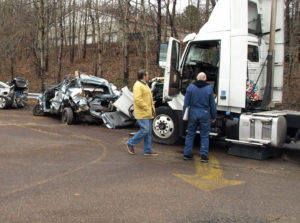
According to data from the National Highway Traffic Safety Administration (NHTSA), Philadelphia has the highest rate of traffic-related deaths per 100,000 residents. In 2023, there were 8.48 deaths per 100,000 in Philadelphia, compared to 2.75 in New York City and 3.36 in Boston. Most traffic deaths and serious injuries in Philadelphia occur on only 12% of the city’s streets labeled as the High Injury Network.
When there is an 18-wheeler accident on Philadelphia roads, it can cause more serious injuries, including fatal injuries, and they can be far more complex legally.
If you have been in a truck accident, you need to know that responsibility might fall not only on the driver but also on other “behind-the-scenes” parties.
Liable parties can include the truck driver, the truck owner, the trucking company, the large commercial truck manufacturer, and more. To complicate matters, many trucking companies deny fault regardless of the circumstances of your Philadelphia truck accident. To discover who is responsible for your accident, you will need the help of an experienced 18-wheeler truck crash attorney to investigate the accident and determine who is at fault.
Why Do Truck Accident Claims Often Involve Multiple Parties?

Although truck driver negligence is often to blame, there are many other potential defendants in truck accident cases.
For example, after a truck accident on I-95, it was discovered that the truck driver had been under the influence while driving. The driver had been drinking at a bar 2 hours prior to setting off for a delivery and was found to have been over the blood-alcohol limit by a police officer at the scene.
If it’s determined that the trucking company hired the driver despite past DUI convictions, the trucking company can also be held responsible for the accident under negligent hiring laws.
The bar that served the driver may also be held responsible under Pennsylvania’s dram shop laws. If the bar continued to serve alcohol despite the driver being visibly intoxicated, they then become financially and legally liable for any subsequent injury or death to a third party caused by the patron.
Potential at-fault parties in a Philadelphia truck accident include:
- The truck driver
- Owner of the truck or tractor-trailer
- The person or company that leased the semi-truck or trailer from the owner
- Manufacturer of the vehicle, tires, or other parts that may have contributed to the cause or severity of the accident
- Shipper or loader of the truck’s cargo (in cases involving improper loading)
- Bars or establishments serving alcohol
Proving these cases can be difficult because trucking, hauling, and leasing companies will deny responsibility. In Philadelphia truck accident cases, they will try to deny fault to avoid paying compensation to the victim.
To help you navigate how to build your personal injury case, you’ll need an experienced Philadelphia 18-wheeler accident attorney fighting for you.
What Are the Common Types of 18 Wheeler Accidents?
 There are several different types of accidents you can get into with an 18 wheeler in Philadelphia. Some of the most common types of trucking accidents include:
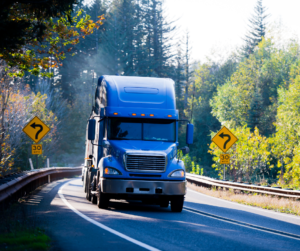
- Jackknife accidents. Semi-truck vehicles fall under the articulated category called “articulated vehicle [2]” that are cars made from different segments connected by movable joints. A jackknife accident occurs when the trailer swings around and causes the truck to fold in on itself at a 90-degree angle
- Truck rollovers. One of the most devastating collisions, truck rollovers can occur because the center of gravity of 18 wheelers and other large commercial trucks is significantly higher than that of regular passenger cars. Truck drivers must exercise extreme caution when making sharp bends or unexpected swerves. The trailer may flip and roll the entire vehicle onto one side if drivers make too many sharp turns or drive too quickly for the road conditions, creating a hazardous, perhaps fatal situation for the truck driver and other motorists. Rollover collisions can be the result of a negligent truck driver’s recklessness, such as speeding, distracted or fatigued driving, or driving while intoxicated.
- T-Bone collisions. The majority of T-bone collisions, also known as side-impact or broadside collisions, take place at intersections. Sometimes, tractor-trailers and other large trucks will disregard stop signs, run red lights, or otherwise fail to yield the right-of-way, resulting in “T”-shaped collisions with the sides of other vehicles. Drivers or passengers who are seated on the side of the car that receives the brunt of the force in a T-bone collision frequently suffer the most severe injuries in these collisions. T-bone collisions can be legally caused by truck drivers who are speeding, inattentive, tired, or drunk, running through junctions. Another scenario that can result in a T-bone collision is when a truck driver improperly turns across one or more lanes of traffic, slamming into the side of another vehicle.
- Rear-end collisions. Due to the sheer size and weight disparity between large commercial trucks and passenger vehicles, truck drivers require a lot more space and time to slow down, avoid obstacles in the road, or come to a safe stop behind other vehicles. Devastating rear-end collisions with other vehicles can occur when truck drivers are inattentive, speeding, or tailgating. Rear-end collisions can also be caused by intoxicated driving and driver fatigue. Inexperienced or hurried truck drivers who disregard the guidelines for following distances set by the Federal Motor Carrier Safety Administration (FMCSA) also put other people in danger by failing to give themselves enough room to slow down.
- Head-on collisions. Any driver can drift out of their lane and directly into the path of oncoming traffic when they are careless, reckless, or simply lose control of their cars. When cars disregard the proper right-of-way at stop signs, red lights, or other junctions, head-on crashes between any two vehicles can occur. However, when a big, heavy commercial truck collides with a passenger vehicle, the results can be devastating. The truck driver may be drowsy from working long hours to satisfy strict quotas, causing them to wander into opposing lanes of traffic. Drivers may be impaired by alcohol or illicit drugs while they are on the road, causing them to lose control and steer into the direction of approaching traffic. Tire blowouts, which frequently result in rollover collisions, may also cause a truck to lose control and veer into opposing traffic.
How Do Trucking Companies Try to Avoid Liability After a Crash?
 If you or a loved one has been seriously injured in a Philadelphia 18 wheeler truck accident, you want to make sure that everyone who was at fault is held accountable. It’s common for truck drivers and their insurance companies to contest responsibility in all truck accident cases, regardless of fault.
Even if the truck driver was obviously at fault, you should never assume that dealing directly with truckers and their insurance companies will be in your best interest.
It is not the purpose of trucking firms or insurance companies to give compensation to truck accident victims. They are there to make money and keep the money they make.
They will try everything in their toolkit to settle truck accident claims for as little as possible. The truck drivers, the trucking company, and their insurance companies will attempt to minimize or completely reject your claim.
Here are some of the ways trucking companies avoid paying just compensation to victims of 18 wheeler crashes:
- They will deny liability outright. The simplest strategy is to simply deny responsibility. Almost all trucking companies instruct their drivers to deny fault after an accident. Many truck drivers are trained to admit nothing and never apologize (which can be construed as a passive admission of guilt) to accident victims. 18 wheeler commercial truck companies and their insurance company know that accepting liability means paying out. Denying liability is their best defense to avoid paying a personal injury claim or wrongful death claim.
- They will get their lawyers involved. Why do you need a good Philadelphia personal injury attorney in your corner after a trucking accident? Because the trucking company will have its workers working overtime almost immediately. A truck driver’s or trucking company’s lawyers will launch into their own investigation right away and then twist the evidence to weaken your truck accident case. They will hide damning evidence and work tirelessly to save the trucking company money.
- They will delay compensation payments. Following an 18 wheeler crash, the truck company, driver, and insurance company all know that the victim is facing seemingly insurmountable medical bills, possible lost wages, and possible unexpected funeral costs. In addition to all of the emotional stress and anxiety victims experience after a truck crash, they are also under a lot of financial pressure. The companies know that victims can start to feel more and more desperate the longer it takes for their claim to be approved. They know that victims who are forced to wait for just compensation will be more willing to accept any settlement that comes their way.
What Are the Most Common Causes of Philadelphia 18 Wheeler Accidents?
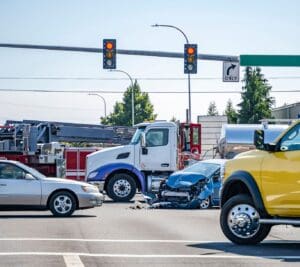
If you or a loved one suffered injuries or loss due to a truck accident, you are not alone. According to data from the National Safety Council (NSC), in 2023, there were 114,552 large truck crashes in the United States; 5,375 were fatal, accounting for 9% of all fatal crashes.
Common causes of truck accidents include driver negligence or recklessness, faulty truck tires or brakes, and irresponsible behavior by trucking companies. Your or your loved one’s large truck accident may have been caused by one or a number of these factors. If so, you deserve compensation for your injuries and property damage.
Overspeeding/ Overtaking
Speeding and unsafe overtaking are major contributors to 18-wheeler accidents. Large trucks require significantly longer stopping distances than passenger vehicles, and higher speeds reduce a driver’s ability to react to traffic changes or hazards.
When truck drivers exceed speed limits or attempt risky overtaking maneuvers, the likelihood of losing control, rear-end collisions, and jackknife accidents increases. Federal safety guidelines emphasize that commercial drivers must adjust speed based on road, traffic, and weather conditions. Failure to do so can result in serious or fatal accidents and may establish liability in a truck accident claim.
Driver Fatigue
Driver fatigue is one of the most well-documented hazards in the trucking industry and a leading cause of 18-wheeler accidents. Long hours, extended routes, and tight delivery schedules can lead drivers to skip rest breaks or drive while drowsy. Fatigue slows reaction times, impairs judgment, and can be as dangerous as driving under the influence.
To reduce this risk, federal Hours-of-Service (HOS) regulations enforced by the Federal Motor Carrier Safety Administration strictly limit how long commercial drivers can operate without rest. Most property-carrying drivers may drive a maximum of 11 hours after 10 consecutive hours off duty and must take a 30-minute break after 8 hours of driving. Violations of these rules can be critical evidence in determining liability after a truck accident.
Distracted Driving
Distracted driving is a growing safety crisis on American roads and a leading cause of 18-wheeler truck accidents. Distractions generally fall into 3 categories: visual (taking eyes off the road), manual (taking hands off the steering wheel), and cognitive (taking the mind off driving).
When a truck driver is distracted, even for a few seconds, the consequences can be catastrophic due to the size and weight of commercial vehicles. Common examples include texting or using a cellphone, checking GPS systems, eating or drinking, adjusting in-cab controls, or reviewing delivery paperwork while driving.
According to the NHTSA, thousands of lives are lost each year in crashes involving distracted drivers. For truck drivers, the risks are even greater because long stopping distances and limited maneuverability leave little room for error.
Trucking companies and drivers have a duty to follow strict safety regulations, including restrictions on the use of handheld devices. When these rules are ignored and distraction leads to a crash, injured victims may have the right to pursue compensation for their losses.
Driver Negligence or Recklessness
A truck driver’s failure to act in a way that shows a reasonable duty of care to other drivers on the road can demonstrate the driver’s part in causing the accident. Both driver negligence and recklessness may be factors in your accident.
Negligence is one of the main factors we consider in analyzing the truck driver’s part in causing the accident. All drivers are expected to act in a way that shows reasonable care towards others. However, when drivers inadvertently fail to demonstrate their expected standard of care, they may cause accidents.
For example, a truck driver may be considered negligent for failing to take proper rest breaks. This can easily lead to driving while drowsy. Tired driving can be extremely dangerous, especially while operating large machinery such as a tractor-trailer. Even though this may be done inadvertently, the driver is negligent nonetheless.
Sometimes drivers may act intentionally, knowing their actions endanger the lives of those around them. This is known as recklessness. Some examples of recklessness include driving while texting, driving while impaired by alcohol, and speeding.
Failure to Adjust to Weather Conditions
Philadelphia experiences frequent weather shifts throughout the year, which can affect road conditions. We see low visibility due to rain, fog, and snow, as well as icy sleet and frozen icy roads, and sometimes heavy winds. Bad weather can lead to bad accidents, especially when an 18-wheeler is involved.
According to the Federal Highway Administration (FHWA), there are, based on 2019-2023 averages, more than 744,000 weather-related motor vehicle accidents annually in the United States. These crashes resulted in over 3,800 fatalities and almost 270,000 injuries per year.
Failure to Properly Inspect Tires and Brakes
Large semi-trucks usually have 18 wheels and a total of 10 air compression brakes. If any of these are not functioning properly, they may cause the truck to lose control or be unable to stop. Maintenance and inspection of large trucks are essential, especially given the mileage these vehicles accumulate.
It is the trucking company’s responsibility to make sure that their vehicles are road safe. According to the Federal Motor Carrier Safety Administration, drivers should check their vehicles at the end of every workday and make a report. Furthermore, a full inspection must be completed every 12 months. If a company fails to make these inspections or keep proper records, it may be held liable for an ensuing accident caused by a vehicle malfunction.
Pressure to Meet Deadlines
Long-distance 18-wheeler deliveries fuel the online shopping economy and have become even more prevalent and essential. Consequently, trucking and retail companies may be under extreme pressure to deliver in shorter timeframes. Companies often impose strict deadlines on their truck drivers.
These deadlines may prevent the driver from taking a needed rest break, leading them to drive while fatigued. When deadlines become impossible to meet, drivers may exceed the speed limit to meet them. The pressure a trucking company places on its drivers to meet quotas can directly affect tractor-trailer accidents.
Frequently Asked Questions About 18 Wheeler Accidents in Philadelphia
How Much Can I Receive for My Truck Accident Case?
 It can be difficult to give an exact figure of how much you may receive following a Philadelphia truck accident. All truck crashes are different so what one injury victim receives is not the same for another. During your first consultation, our Philadelphia truck accident attorney will sit down with you and go through all the expenses you have following the accident.
We can then come up with an educated estimate of how much your truck accident claim is worth.
What is the “Black Box” and is it Important to My Case?
Most people might not be aware that many large trucks, like airplanes, have an information-recording “black box” on board. These “black boxes” may provide vital details regarding how and why an accident took place. They keep track of the truck’s speed, GPS position, seatbelt use, steering angle, braking duration and force, airbag deployment, cruise control settings, tire pressure, and much more.
Black boxes capture factual data regarding collisions, and the information can be used as critical evidence in a lawsuit for personal injuries brought against a truck driver or company. However, obtaining this information can be challenging because most devices destroy records automatically after 30 days, and a trucking company might be reluctant to release the information.
Are 18 Wheeler Accidents More Dangerous Than Car Accidents?
Absolutely. After a tractor trailer accident you might be suffering from serious injuries. Spinal cord injuries, head injuries, traumatic brain injury (TBI), internal injuries, and even serious injury leading to the loss of a loved one are far more common in semi truck accidents.
What Makes Truck Accident Cases More Complex Than Car Accidents?
Truck accident claims involve federal regulations, multiple liable parties, and high-value insurance policies. Investigations are more detailed and often require expert testimony. The stakes are higher, and the defense is more aggressive. This complexity makes experienced legal counsel essential.
Do Trucking Companies Always Carry Large Insurance Policies?
Yes, federal law requires commercial trucks to carry higher insurance limits than passenger vehicles. Policies often range from $750,000 to several million dollars. However, insurers fight aggressively to limit payouts. A proper legal strategy is key to accessing full compensation.
Can a Trucking Company Be Liable for a Driver’s Actions?
Yes, a trucking company can be held liable for a driver’s actions. Under the legal doctrine of vicarious liability, employers can be held responsible for employee negligence. Additionally, companies may be directly liable for unsafe policies, poor training, or regulatory violations. Identifying all liable parties increases your potential compensation.
What Should I Do Immediately After a Truck Accident?
Seek medical attention, call law enforcement, and document the scene, if possible. Avoid speaking with insurance adjusters before consulting a lawyer. Early legal guidance helps protect your claim. The sooner an investigation begins, the stronger your case can be.
If You Were Injured in an 18 Wheeler Accident in Philadelphia, Don’t Wait. Call Munley Law Personal Injury Attorneys
After a serious truck accident, you need a law firm with proven results in complex trucking litigation. At Munley Law Personal Injury Attorneys, we bring almost 70 years of experience and a nationally recognized track record of securing substantial verdicts and settlements for injured clients.
Munley Law has three attorneys board-certified in Truck Accident Law by the National Board of Trial Advocacy – a distinction no other Pennsylvania firm holds. Marion Munley and Daniel Munley also serve in leadership roles with the American Association for Justice Trucking Litigation Group and are board-certified by the Academy of Truck Accident Attorneys.
We handle every aspect of your case – from investigating the crash and preserving evidence to negotiating with insurers and taking your case to trial if necessary. Our focus is simple: fighting for compensation while you focus on recovery. Contact us today for a free consultation.

Daniel W. Munley
Daniel W. Munley is a nationally recognized, leading truck accident lawyer. He has been board certified in Truck Accident Law by the NBTA as well as being a charter member for the American Association for Justice Trucking Litigation Group. Daniel often takes part in speaking engagements presenting the latest cutting-edge technology and trial techniques to help attorneys nationwide protect the rights of truck accident victims. Additionally, Daniel has secured numerous multi-million dollar settlements for victims, including the largest truck accident settlement for an individual plaintiff on record in Northern Pennsylvania, at $26 million.