Why Does a Truck’s GVWR Matter for Drivers on I-81 Near Scranton?
Commercial trucks are a common sight on Scranton’s highways and throughout Northeastern Pennsylvania. Because these vehicles can weigh up to 40 times as much as the average passenger car, even small violations of federal safety standards can have serious consequences.
One of the most important safety measurements for any commercial truck is its gross vehicle weight rating (GVWR). While most drivers never think about GVWR, it plays an important role in preventing crashes and can become a critical factor when investigators determine why a truck accident occurred.
What Does a Truck’s GVWR Cover?
A truck’s Gross Vehicle Weight Rating is the maximum amount of weight a vehicle is designed to carry safely. This number is assigned by the manufacturer after engineers evaluate the truck’s frame, suspension, axles, brakes, tires, and other components.
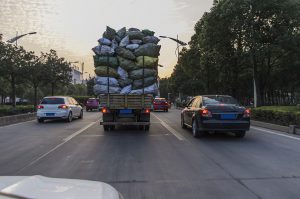 Federal law, at 23 U.S.C. Section 127, separately caps most tractor-trailers on the Interstate System, including I-81 and I-84 through Lackawanna County, at 80,000 pounds gross weight, 20,000 pounds on a single axle, and 34,000 pounds on a tandem axle.
A truck can stay under those federal road limits and still exceed its own manufacturer’s GVWR, because the two numbers measure different things. One is an engineering limit set for that specific vehicle. The other is a public-safety limit set for the road itself. Pennsylvania State Police Motor Carrier Enforcement units and PennDOT inspectors both have the authority to pull a truck for a roadside weight check, and that inspection record often becomes part of the evidence in a later claim.
How Does an Overloaded Truck Behave Differently on the Road?
A truck loaded past its GVWR needs a longer stopping distance, responds more slowly to steering input, and puts extra strain on brakes that were never designed to carry the added weight. That matters most right now around the Throop-Dunmore interchange in Lackawanna County, where I-81, I-84, and I-380 converge, and PennDOT began a $124 million pavement replacement project in April 2026 that will run through 2031, the second-most expensive project in the department’s District 4 history.
Construction zones mean narrowed lanes, shifted traffic patterns, and more sudden braking, exactly the conditions where an overloaded truck’s longer stopping distance becomes dangerous. Tire failures, brake overheating, jackknifing, and rollovers all become more likely when a truck already operating at its limit has to react quickly to a lane shift or a line of slowing traffic.
Because the project is expected to run for several years, these are not short-term conditions. Anyone regularly driving this interchange will be sharing the road with construction equipment and shifting lane patterns well into the next decade.
Is a Truck’s GVWR the Same as Pennsylvania’s Legal Weight Limit?
No, they are two separate limits.
GVWR is set by the manufacturer and represents the maximum weight a specific truck can safely carry. Pennsylvania law, meanwhile, sets legal weight limits for vehicles traveling on public roads to protect motorists and prevent excessive damage to highways and bridges.
For example, most commercial trucks operating on interstate highways are limited to a gross weight of 80,000 pounds without a special permit. However, a truck could violate its manufacturer’s GVWR even if it remains within legal roadway weight limits. Likewise, a truck with a high GVWR may still exceed Pennsylvania’s legal weight restrictions if it carries too much cargo.
Both types of violations may become relevant during a truck accident investigation.
How Do Trucks Become Overloaded?
Overloaded trucks are not always the result of a driver’s decision. Commercial freight often changes hands multiple times before reaching its destination, and responsibility for loading may fall on warehouse employees, shipping companies, or third-party cargo handlers.
Sometimes, cargo weights are miscalculated. In other cases, freight is loaded unevenly, or additional shipments are added to maximize efficiency without fully accounting for the truck’s safe operating limits. Tight delivery schedules and pressure to increase profits can also contribute to unsafe loading practices.
Because several companies may be involved in preparing a shipment, determining who is responsible for an overloaded truck often requires a detailed investigation.
What Role Does GVWR Play in a Truck Accident Investigation Near Scranton?
 After a serious crash at or near the Throop-Dunmore interchange, or anywhere else along I-81, I-84, or I-380 runs through Lackawanna County, investigators first determine whether the truck involved was operating within its GVWR before examining much else about how the crash happened. That review usually pulls from scale tickets, shipping manifests, electronic logging device data, and the carrier’s own maintenance and inspection records, since a truck that was overloaded may also have been carrying deferred maintenance that made the overload more dangerous.
Finding a GVWR violation does not by itself prove who is at fault. It can, however, help explain why a truck failed to stop in time, drifted out of its lane, or lost a wheel under load, and it can point toward which company along the shipping chain, the carrier, the shipper, or the warehouse that loaded the trailer, bears responsibility.
Pennsylvania follows a modified comparative negligence rule, so a carrier, shipper, and warehouse can each bear a share of that responsibility, though a plaintiff found more than half at fault cannot recover damages at all, which is one reason a full accounting of who loaded and dispatched the truck matters.
Claims arising from a Lackawanna County crash are generally filed in the Lackawanna County Court of Common Pleas in downtown Scranton, where a judge ultimately weighs that evidence alongside everything else in the case.
A crash involving an overloaded commercial truck is stressful enough without also trying to track down scale tickets, shipping records, and maintenance logs on your own. Munley Law, headquartered a few blocks from the Lackawanna County Courthouse in downtown Scranton, has represented people injured in serious truck crashes throughout Lackawanna County for more than six decades. Contact our Scranton truck accident lawyers today for a free consultation.

Marion Munley
Marion Munley is one of the nation’s most decorated and respected truck accident lawyers. Having contributed to numerous publications and spoken at numerous conferences, she has advocated for truck accident victims nationwide. Marion is Board Certified in Truck Accident Law by the NBTA and is the first woman to become Chair of the AAJ Trucking Litigation Group in 2018 – additionally, she was named “Top 10 Trucking Trial Lawyers” by the National Trial Lawyers Association. Marion has assisted in several landmark truck accident settlements, including a $26 million settlement for a single mother of three who was critically injured when a tractor trailer collided with her car.
 Call us at (844) 686-5397
 Posted in Truck Accidents.