Can an Allentown Renter Sue Their Landlord for an Injury at Home?
The landlord is usually liable when an unsafe condition in an Allentown rental property causes a tenant’s injury, and the tenant often has an unusual advantage in proving it: the city’s own rental inspection records.
Allentown runs one of Pennsylvania’s most active rental inspection programs, which means that a landlord’s history of code violations, failed inspections, or an expired rental license can serve as evidence in the case rather than requiring the tenant to prove it from scratch.
What Legal Standard Applies When an Unsafe Rental Property Causes an Injury?
In a premises liability claim, the standard against which a landlord’s conduct is measured derives from the Pennsylvania Supreme Court’s 1979 decision in Pugh v. Holmes, which requires that rental housing be safe and sanitary regardless of what the lease says. This standard doesn’t exist to give a tenant a way to compel repairs. It is in place to define what a landlord should have caught and fixed before someone got hurt. 
Notice is what turns this standard into negligence. A landlord who knew about a hazard, whether from a tenant’s report or a routine inspection, and left it unaddressed long enough for someone to get hurt is in a very different legal position than one who never had a chance to learn about it. How much time passed between notice and the injury is often the central fact in the case.
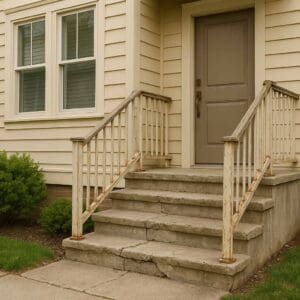
The standard isn’t just limited to heat and plumbing. A structural defect like a rotted porch, a broken exterior staircase, or a railing that was never anchored correctly can fall below the same safety standard as a leaking roof, and it poses a far greater risk of physical injury than an inconvenience like a broken dishwasher.
How Does Allentown’s Rental Inspection Program Affect an Injury Claim?
Allentown’s Rental Unit Registration and Inspection Program requires every residential rental unit in the city to carry an active annual license and pass a city inspection at least once every five years, or sooner if a complaint is received. The program uses 14 housing inspectors and can fine a landlord up to $1,000 per unit per month for operating out of compliance.
These records are important to an injury claim because they create a paper trail independent of the tenant’s own account. A landlord who let a rental license lapse, failed an inspection, and never corrected the violation, or was cited for the exact defect that caused the injury, has effectively left the city holding evidence of the hazard.
An Allentown premises liability attorney can request these inspection and licensing records to show the landlord had, or should have had, direct knowledge of the problem.
What Should an Injured Renter Do Right After the Accident?
An injured tenant should get medical treatment first, then photograph the hazard, whether it’s a rotted porch board, a broken stair rail, exposed wiring, or a mold-covered ceiling, before a landlord has any chance to repair or remove it. Save every text, email, or maintenance request sent to the landlord about the condition, even ones sent months before the injury.
A tenant should also write down the date and time of the accident while the details are still fresh, along with the names of any neighbors or guests who witnessed it. If city inspectors or police responded, request a copy of that report directly, since it becomes part of the same record an attorney will later pull from the Bureau of Building Standards and Safety.
Reporting the hazard to the landlord in writing after the accident, not just informally by phone or in person, also creates a timestamped record that the landlord can’t later claim never existed. A tenant doesn’t need to wait for the landlord’s response before seeking legal advice, especially if the same defect has already caused a near-miss or a prior complaint from another tenant in the building.
Does a Prior Complaint About the Hazard Strengthen an Injury Claim?
Yes. A tenant who already reported the hazard to the landlord in writing has strong evidence that the landlord knew about the problem and had time to fix it before the injury happened. Once a hazard has been reported and not fixed within a reasonable time, any resulting injury is far harder for the landlord to call unforeseeable, which is the central question in a negligence claim.
A tenant who hasn’t complained yet isn’t out of options. Photos, the city’s inspection history for the address, and the visible condition of the defect itself can all establish that the hazard existed long enough for a landlord conducting reasonable upkeep to have caught it.
The condition of a defect often speaks for itself. Rotted wood, rusted-through railings, and wiring with cracked or missing insulation don’t happen overnight, and a defect visibly built up over months or years undercuts any argument that the landlord had no way of knowing.
How Long Does an Injured Allentown Renter Have to File a Claim?
An injured tenant in Allentown has two years from the date of the injury to file a premises liability claim. This deadline runs regardless of whether the tenant is still living in the unit or has since moved out.
Waiting to act carries a specific local risk in Allentown, as rental units are reinspected on a rolling cycle, and a hazard can be repaired, or the whole property can change ownership long before a tenant who waited gets around to pulling records. Requesting the inspection file and documenting the hazard early on preserves evidence that might not exist in the same form a year later.
A change in ownership doesn’t erase a tenant’s claim, but it does make the investigation harder. The new owner may not have the prior landlord’s maintenance records, and the city’s licensing file transfers to a new account, which is one more reason to request records while the property is still under the landlord who owned it at the time of the injury.
A tenant harmed by a hazard the landlord already knew about and failed to fix shouldn’t have to build the case alone while also recovering from the injury. Munley Law has represented premises liability victims across the Lehigh Valley for nearly 70 years. Contact us for a free consultation.

James Christopher Munley
James Christopher Munley is an award-winning and trusted premises liability lawyer. Chris is a board-certified civil trial advocate and has been named to the Best Lawyers in America and the Lawdragon 500 Leading Lawyers in America. Chris has also been appointed to the Top 100 Trial Lawyers in Pennsylvania by the National Trial Lawyers Association and is among the Pennsylvania Super Lawyers since 2005.
 Call us at (844) 686-5397
 Posted in Premises Liability.