When Are Scranton Bars and Restaurants Liable for a Slip and Fall?
A Scranton bar, restaurant, or commercial property is liable for a slip and fall when it knew, or reasonably should have known, about a dangerous condition and failed to fix it or warn customers in time. This standard applies to the more than 50 restaurants, bars, and cafes all packed into downtown Scranton.
What counts as “reasonable” depends on the hazard. How long did it exist? And did the business have a real chance to catch it before someone got hurt?
What Legal Duty Does a Scranton Bar or Restaurant Owe Its Customers?
Pennsylvania law treats a paying customer at a bar or restaurant as a business invitee. Invitee status carries the highest duty a property owner owes anyone on the premises. The courts apply Section 343 of the Restatement (Second) of Torts directly, which means that an owner is liable if they: 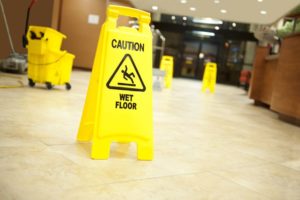
- Knew or should have discovered the hazard
- Should have realized the danger it posed
- Should have expected that customers would not protect themselves against it
- Still failed to fix or warn customers about it
This is a four-part test. A Scranton slip and fall claim usually comes down to which of those four points the evidence supports, or fails to support. This is a higher duty than a business owes a mere licensee or an uninvited trespasser, and it applies just as much to a first-time customer as to a regular who has visited a hundred times.
Does a Business Have to Warn About Obvious Hazards?
Not automatically. Under Section 343A of the Restatement, a business is generally not liable for a hazard that is open and obvious, since customers can see it and avoid it themselves.
A wet floor sign, a cordoned-off spot, or good lighting on a step can satisfy that duty. A single unaddressed hazard, repeated over multiple shifts, can turn a minor puddle into a pattern of neglect a jury will notice.
But the exception has its own exception.
If a business should reasonably expect a customer to encounter the hazard anyway, because the space is crowded, the lighting is dim, or a patron’s attention is elsewhere, the “obvious” defense does not automatically end the case.
A busy Friday night at a downtown Scranton bar, with a packed room and a narrow path to the restroom, is exactly that kind of setting.
Restaurants and bars in older downtown Scranton buildings often deal with uneven flooring or low door thresholds that are original to the structure. Simply pointing out that the threshold exists is rarely enough. The business still needed to take steps such as better lighting, warning tape, or a handrail to reduce the risk it posed.
What About Ice and Snow Outside a Downtown Scranton Bar or Restaurant?
Pennsylvania’s “hills and ridges doctrine” protects a property owner from liability for a fall caused by slippery conditions from a recent snow or ice storm. To win a claim, an injured person has to show three things:
- The snow or ice built up into ridges or elevations that obstructed the sidewalk
- The owner knew about it, and
- The owner failed to clear it within a reasonable time
The doctrine has two exceptions. An isolated patch of ice in an otherwise clear, dry area is not protected. Neither is ice caused by the property’s own negligence, such as a leaking gutter or an air conditioning unit dripping onto the entrance.
In Scranton, as in most Pennsylvania cities, the property owner or business occupying a downtown storefront is responsible for clearing its own sidewalk, not the city.
Who Is Responsible if the Property is Leased to the Business?
It depends on the lease. Many buildings in downtown Scranton are older mixed-use properties, with a ground-floor business leasing space from a separate landlord who owns the building.
As a general rule, the landlord remains responsible for structural elements and common areas it controls, such as the exterior sidewalk, the front steps, shared stairwells, and hallways. The tenant business is responsible for the condition of its leased space, including the dining room floor, bar area, and restrooms.
A single fall, such as one on a building’s front steps that were never repaired, can sometimes implicate both parties. This maintenance clause, along with who is named on the property’s insurance policy, usually determines which insurer handles a claim, and both can be found in Lackawanna County property records or the lease itself.
How Does Fault Get Divided in a Pennsylvania Slip and Fall Claim?
Pennsylvania follows a modified comparative negligence rule. A court can reduce a settlement or verdict by the injured person’s own percentage of fault, and bar recovery entirely if that person is found more than 50% at fault. 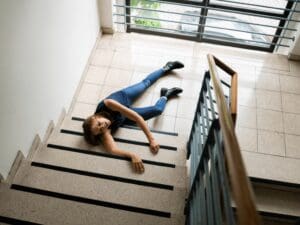
In a bar setting, a defense attorney will often argue that a customer’s own intoxication contributed to a fall. This argument can succeed if the evidence shows the customer’s condition, not the property’s condition, caused the accident. It does not automatically defeat a claim, since a dangerous floor or stairway can still be the primary cause even when a customer had been drinking.
Insurance adjusters know this, which is why they often ask for a recorded statement from the injured customer before the customer has spoken with a slip and fall accident attorney. Surveillance footage from the bar itself, if preserved before it is overwritten, is often the most direct evidence of what happened and how quickly staff responded.
Claims arising from a fall in Lackawanna County are filed in the Lackawanna County Court of Common Pleas in downtown Scranton, where a judge or jury weighs how much each side’s conduct contributed to the fall.
Local Legal Representation Can Help Your Case
A serious fall at a bar or restaurant often means real injuries, and a business that is quick to say the hazard was obvious or that the injured person was at fault.
Munley Law, headquartered a few blocks from the Lackawanna County Courthouse in downtown Scranton, has represented people injured in falls at commercial properties throughout Lackawanna County for nearly seven decades.
Call our premises liability lawyers today to schedule a free consultation.

James Christopher Munley
James Christopher Munley is an award-winning and trusted premises liability lawyer. Chris is a board-certified civil trial advocate and has been named to the Best Lawyers in America and the Lawdragon 500 Leading Lawyers in America. Chris has also been appointed to the Top 100 Trial Lawyers in Pennsylvania by the National Trial Lawyers Association and is among the Pennsylvania Super Lawyers since 2005.
 Call us at (844) 686-5397
 Posted in Premises Liability.