Heavy Truck Crashes on Route 422 and Route 61 in Berks County: How to Sue the Trucking Company — Not Just the Driver
A serious truck crash in Berks County is rarely just about the driver. It is almost always about the trucking company that hired the driver, set the schedule, and owns the truck. Once the company is named as a defendant, the insurance available to cover your injuries grows by ten or twenty times what a personal auto policy would pay.
If you were hurt in a truck crash on Route 422 or Route 61 in Berks County, contact the Munley Law truck accident lawyers in Reading, PA. The first consultation is free.
Why Berks County Truck Crashes Look Different From the Rest of Pennsylvania
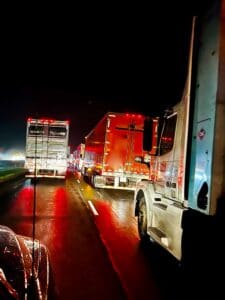 Berks County sits at the center of one of the most active East Coast logistics corridors. Route 422, Route 61, I-78, and Route 222 connect dozens of warehouses and distribution centers to the Philadelphia and New York metro markets. Many of these trucks are operated by drivers under tight delivery deadlines, by carriers running on thin operating margins, or by independent contractors whose actual relationship with the company looks a lot more like employment than the contract claims.
This matters for liability. Most truck crashes in Berks County are not random accidents involving a stranger from out of state. They are the predictable result of the carrier’s hiring, training, scheduling, and maintenance of the truck involved. A Berks County jury sees that pattern, and so does a Berks County Court of Common Pleas judge.
What Route 422 and Route 61 Crashes Tell Us About Company Liability
Different roads produce different crash patterns, and different crash patterns point to different forms of company responsibility.
Route 422 and the West Shore Bypass. PennDOT data found that the Route 422 interchange at Lancaster Avenue is the single most dangerous spot in Berks County, with 94 crashes over a 10-year stretch. Route 422 has left-side exit ramps that catch drivers by surprise, and the West Shore Bypass dates to the late 1950s. When a tractor-trailer rear-ends a passenger car at one of these merges, the typical question is not whether the driver was at fault, but whether the carrier ever properly trained that driver on local routes, whether the dispatcher pushed the driver into a window of fatigue, and whether the truck’s brake maintenance was actually performed. These point to negligent training and FMCSR violation arguments, not just driver-negligence ones.
Route 61 north of Reading. Route 61 climbs and descends through Hamburg, Shoemakersville, and Mohrsville on its way up to Schuylkill County. Heavy trucks running this grade experience recurring brake fade and downhill-control issues. A truck that loses control on a Route 61 grade points hard at maintenance logs, the carrier’s inspection schedule, and the electronic control module data showing whether brake performance had been degrading before the crash.
The warehouse and distribution corridor. Crashes near Berks County distribution centers raise a different question: who really employs the driver? Many carriers treat their drivers as independent contractors on paper while controlling the routes, schedules, equipment, and uniforms in practice. Pennsylvania courts look at the actual relationship, not the contract label. When a court finds the driver was effectively an employee, the carrier’s policy is back in play.
Four Ways the Trucking Company Becomes a Defendant
Pennsylvania law gives crash victims four well-established routes to put a trucking company on the hook for what its driver did: vicarious liability, negligent hiring, negligent entrustment, and Federal Motor Carrier Safety Regulation violations. Each one provides access to commercial insurance policies that typically range from $1 million to $5 million per occurrence with national carriers, far above the $750,000 federal minimum.
For a deeper look at each theory, see our overview at When is the Trucking Company Liable? and our FMCSA Regulation Violations page. What matters in a Berks County case is not the legal definitions, but how quickly your attorney can identify which theory fits your crash and start preserving the carrier-controlled evidence that proves it.
Three Questions Berks County Truck Crash Victims Ask Us
How quickly does a trucking company’s evidence disappear?
Federal rules require carriers to retain electronic logging device (ELD) data for six months. In practice, in-cab camera footage, black-box recordings, and dash cam files are often overwritten on 30 to 90-day cycles. Driver qualification files, drug-test results, and maintenance logs follow their own retention rules. The single most important early step in a Berks County truck case is for an attorney to send a spoliation letter, which is a formal legal demand that the company preserve specific records. The earlier this happens, the more evidence
survives.
Where will my Berks County truck case be filed?
Most Berks County truck crash claims are filed in the Berks County Court of Common Pleas in Reading. Local jurors here see the warehouse and distribution traffic on these roads every day, and they understand how a carrier’s bad scheduling or shortcut maintenance puts everyone on the road at risk. Cases involving out-of-state carriers may sometimes be filed in or removed to federal court in the Eastern District of Pennsylvania. Your attorney will walk through that question with you.
What if the truck driver was listed as an independent contractor?
That label often does not protect the company. If the carrier controlled the schedule, routes, dispatch, equipment, and required compliance with company policies, a Berks County judge or jury can find the driver was an employee for liability purposes regardless of what the contract called the relationship.
What To Do After a Truck Crash on Route 422 or Route 61
The first hours after a Berks County truck crash shape the rest of the case. The following steps protect both your health and your claim:
- Call 911 and accept medical evaluation at the scene. Reading Hospital (Tower Health) and Penn State Health St. Joseph are the two facilities most often used by patients from Berks County involved in truck crashes.
- Photograph the truck’s company name, USDOT number, license plate, cab number, and any visible damage to both vehicles. The USDOT number is the key to identifying the carrier in federal databases.
- Get the name, phone, and license plate of every witness before they leave the scene.
- Do not give a recorded statement to the trucking company’s insurance adjuster. The adjuster works for the carrier, not for you.
- Contact a Reading truck accident attorney as soon as you are physically able. A spoliation letter sent within the first week can mean the difference between winning and losing a case on the carrier’s evidence alone.
Contact Our Reading Truck Accident Lawyers at Munley Law
A serious Berks County truck crash can put your finances, your health, and your family under sustained pressure. The trucking company’s insurance is built to absorb cases like yours, but only if the company is named as a defendant and the evidence is preserved before it can be lost.
Contact Munley Law to schedule a free consultation with our truck accident attorneys. We represent clients in Reading, Pottsville, Pottstown, Hamburg, Wyomissing, and across Berks County. You pay nothing unless we win your case.

Daniel W. Munley
Daniel W. Munley is an award-winning personal-injury attorney and champion of plaintiffs’ rights. For decades he’s won multi-million verdicts and settlements and is recognized as a national leader in truck and rideshare litigation, including a record $26 million truck settlement in Northeastern Pennsylvania and a $20 million recovery in 2024 for life-altering commercial-vehicle injuries.
 Call us at (844) 686-5397
 Posted in Truck Accidents.