



Thanks to the explosion of warehouses and distribution centers along the I-81 corridor, NEPA has been flooded by commercial truck traffic. So it’s no surprise that truck accidents have been on the rise in Lackawanna County.
One of the most dangerous types of truck accidents is a jackknife accident. Jackknife accidents occur when the trailer swings outward from the cab, forming an angle resembling a folding pocketknife. Once a truck jackknifes, the driver may lose control of the vehicle, and the trailer can block multiple lanes of traffic, triggering chain-reaction collisions involving numerous vehicles.
Because jackknife crashes often result from preventable factors such as improper braking, excessive speed, poor maintenance, cargo shifts, or driver error, determining why the truck lost control is a critical part of any investigation.
Munley Law’s board-certified Scranton truck accident lawyers can identify the factors that contributed to the crash and pursue claims against every responsible party.
Contact us today for a free consultation. We charge no fees unless we win you compensation.
Contact a Truck Accident Lawyer at Munley Law
 Call Us At 844-686-5397
 What Causes a Truck to Jackknife?
A jackknife occurs when the trailer loses traction and begins to swing independently of the tractor. Common causes include: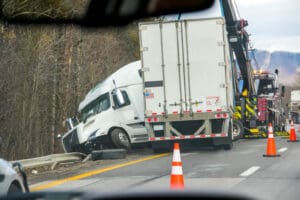
Sudden or Improper Braking
Hard braking can cause a trailer’s wheels to lock up, particularly in poor weather or on slippery roads. When the trailer loses traction while the cab continues moving, the trailer may swing outward.
Speeding or Driving Too Fast for Conditions
Even when a driver is traveling within the posted speed limit, operating too fast for rain, snow, ice, or traffic conditions can increase the risk of a jackknife accident.
Brake Defects and Mechanical Failures
Faulty brakes, worn tires, defective anti-lock braking systems, and other mechanical issues can make it difficult for a driver to maintain control during emergency maneuvers.
Improperly Loaded Cargo
Uneven weight distribution or shifting cargo can destabilize a truck during braking or turning, increasing the likelihood of a jackknife.
Driver Fatigue
Fatigued drivers may react more slowly to hazards and make sudden steering or braking decisions that contribute to loss of control.
Why Jackknife Accidents Often Cause Severe Injuries
Unlike many collisions involving a single point of impact, a jackknife accident can affect vehicles across several lanes of traffic. These accidents are often caused by sudden changes in weather conditions, such as valley fog or ice accumulation, or by steep terrain near Clarks Summit.
These crashes may lead to:
- Multi-vehicle pileups
- Rollovers
- Underride collisions
- Head-on crashes
- Secondary collisions involving stopped traffic
Victims frequently suffer traumatic brain injuries, spinal cord injuries, fractures, internal injuries, and other catastrophic harm, including death. From 2020 to 2023, the FMCSA reported 4,842 fatalities from jackknife truck accidents across the US, reinforcing how common and how fatal these collisions can be.
Who Can Be Held Responsible for a Jackknife Truck Accident?
Although the truck driver is in control of the vehicle at the time of the collision, they are not always the only party responsible for a jackknife accident.
Depending on the circumstances, liability may extend to:
- The trucking company
- A maintenance contractor
- A cargo loading company
- The truck owner
- Parts manufacturers
- Brake or tire manufacturers
For example, a trucking company may be liable if it failed to properly train its drivers, pressured them to meet unsafe delivery deadlines, or neglected required maintenance. A maintenance contractor could be responsible if faulty brake work or missed inspections contributed to the loss of control. Cargo loaders may be at fault if improperly balanced or unsecured freight caused the trailer to shift and destabilize the vehicle.
In some cases, the issue stems from defective components. Worn brake systems, faulty anti-lock braking systems (ABS), or tire blowouts caused by manufacturing defects can directly lead to a driver losing control of the trailer. Even the truck owner may be liable if they failed to ensure the vehicle was properly inspected and roadworthy before use.
Because liability can extend across multiple parties, determining fault in a jackknife accident requires a detailed investigation into how the crash occurred and who contributed to it. This often involves reviewing maintenance records, electronic logging device (ELD) data, inspection reports, cargo manifests, driver qualification files, and black box data, as well as reconstructing the sequence of events leading up to the crash.
Establishing responsibility early is critical, since each potentially liable party may have its own insurance carrier and legal defense team working to limit exposure.
What Evidence Can Be Critical in a Jackknife Case?
Trucking companies often possess much of the evidence needed to understand why a crash occurred. 
Important evidence may include:
- Event data recorder information
- Dash camera footage
- Driver logs
- Inspection and maintenance records
- Cargo loading documents
- Post-crash vehicle inspections
- Witness statements
- Accident reconstruction analysis
In many cases, these records are held exclusively by the trucking company and are not automatically preserved for long periods.
That is why acting quickly matters. Key data from electronic systems can be overwritten, dash camera footage may be overwritten in a loop, and maintenance or inspection records may be altered or lost in the normal course of business. Physical evidence at the scene also changes rapidly as roads are cleared and vehicles are removed.
Preserving this evidence early can be essential to building a strong claim and holding all responsible parties accountable in a jackknife truck accident case.
What Sets Munley Law Apart in Truck Accident Litigation
Truck accident cases require a different level of experience than ordinary motor vehicle collisions.
Munley Law has spent nearly seven decades representing people injured in commercial trucking crashes and is recognized nationally for our work in trucking litigation.
Our attorneys have served in leadership positions with the Academy of Truck Accident Attorneys (ATAA) and the American Association for Justice’s Trucking Litigation Group. Three of our attorneys also hold Board Certification in Truck Accident Law from the National Board of Trial Advocacy (NBTA), a distinction held by a very small number of attorneys nationwide.
Because truck accident cases are so evidence-intensive and often aggressively defended from the outset, a thorough investigation is essential. Our team works closely with accident reconstruction specialists, trucking safety experts, engineers, and other professionals to analyze every detail of a crash.
We also have close working experience with local law enforcement agencies and investigative authorities in the region, including the Scranton Police Department, Lackawanna County Sheriff’s Office, and Pennsylvania State Police crash reconstruction units, as well as familiarity with how reports are prepared and preserved for litigation.
We regularly handle matters through the local court system, including the Lackawanna County Court of Common Pleas in Scranton, where many serious truck accident and catastrophic injury cases are filed and litigated.
By combining decades of legal experience with specialized technical resources, we are able to reconstruct crashes in detail, identify regulatory violations, and build strong, evidence-based cases that hold negligent parties accountable.
Frequently Asked Questions About Jackknife Truck Accidents
Can Bad Weather Excuse A Jackknife Accident?
Not necessarily. Commercial drivers are expected to adjust their speed and driving behavior to road and weather conditions. A crash during rain, snow, or ice does not automatically relieve a driver or trucking company of responsibility.
How Long Do I Have To File a Jackknife Truck Accident Claim?
Pennsylvania law limits the time available to file personal injury claims. In most cases, the statute of limitations is two years from the date of the crash, as set out under Pennsylvania law (including 42 Pa. C.S.A. § 5524(2)). If you do not file a claim within this period, you will likely lose your right to pursue compensation altogether, regardless of how strong your case may be.
Where Do Most Jackknife Truck Accidents Happen In Scranton?
Most jackknift truck accidents happen on the interstates that run straight through our backyard. Such hotspots include:
- I-81 through Lackawanna County
- The I-81 / I-84 / I-380 interchange in Dunmore
- Northeast Extension interchange near Clarks Summit
- The Casey Highway (US-6) toward the Carbondale corridor
- The long I-81 grades descending toward the Wyoming Valley
Why Are Highways High-Risk For Jackknife Crashes?
High speeds, sudden braking, congestion, and limited reaction time make it easier for a trailer to swing out of control, especially during lane changes or downhill driving.
Can I Bring a Jackknife Truck Accident Claim If I Was Partially At Fault For The Accident?
Possibly. Pennsylvania follows a modified comparative negligence rule, which means an injured person may still recover compensation if they were less than 51% responsible for the crash. Any recovery may be reduced based on the percentage of fault.
Contact a Scranton Jackknife Truck Accident Lawyer
A jackknife accident can leave victims facing significant medical expenses, lost income, and long-term recovery. Determining what caused the truck to lose control is often the key to establishing liability and securing compensation.
If you were injured in a jackknife truck accident, contact Munley Law for a free consultation. Our Scranton truck accident attorneys can evaluate your case, explain your options, and begin investigating the factors that contributed to the crash.

Marion Munley
Marion Munley is one of the nation’s most decorated and respected truck accident lawyers. Having contributed to numerous publications and spoken at numerous conferences, she has advocated for truck accident victims nationwide. Marion is Board Certified in Truck Accident Law by the NBTA and is the first woman to become Chair of the AAJ Trucking Litigation Group in 2018 – additionally, she was named “Top 10 Trucking Trial Lawyers” by the National Trial Lawyers Association. Marion has assisted in several landmark truck accident settlements, including a $26 million settlement for a single mother of three who was critically injured when a tractor trailer collided with her car.