
If you’ve spent any time driving on America’s highways, you’ve shared the road with big trucks. Routes like I-10, I-40, I-80, and I-95 are lifelines for goods moving across the country. They are among the nation’s busiest freight corridors, carrying thousands of trucks every day with loads ranging from groceries to construction materials.
For the most part, these trucks get where they’re going without incident. But when something goes wrong, the difference between a car accident and a truck accident becomes painfully clear. A fully loaded truck can weigh up to 80,000 pounds. The sheer force involved often leaves smaller vehicles crushed, people badly or fatally injured, and families dealing with consequences that stretch far beyond the crash itself.
This guide is intended to give you a clear and comprehensive look at how truck accidents work under U.S. law. Our truck accident lawyers will discuss why these crashes are different, what tends to cause them, and what rights you have if you’re involved in one.
You’ll also see how fault is determined, how evidence like “black box” data can make or break a case, and what role insurance companies play along the way. The goal is to give you the knowledge you need to protect yourself and your family, before and after an accident.
Click here to download this guide
Understanding Truck Accidents
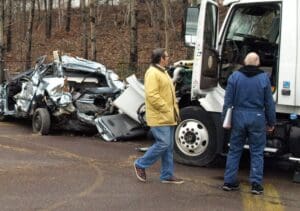 Car accidents can cause serious harm, but when a crash involves a tractor-trailer, the impact is on a different scale. The size of a truck, the way it handles, and the rules that govern its operation all combine to make these accidents far more complicated than a typical collision between two cars.
Trucks need more room to stop, wider lanes to turn, and constant attention to maintenance. A single worn tire or a shifting load can put everyone nearby at risk. On top of that, truck drivers follow strict federal and state regulations that cover everything from how long they can drive in one stretch to how often their vehicles must be inspected.
These details matter because they explain why truck crashes often lead to complex claims. Understanding how truck accidents happen is the first step in understanding how the law deals with them.
Common Types of Truck Accident Causes and Risks
| Accident Type | Description | Common Causes | Risks to Other Drivers |
| Rollover | Truck tips onto its side or roof, often across lanes | Speeding, sharp turns, uneven loads | Crushes vehicles, blocks roadways |
| Jackknife | Trailer swings out at angle to cab, forming “V” | Sudden braking, slippery roads, driver error | Multi-vehicle pile-ups |
| Underride | Car slides under trailer during stop | Sudden stops, missing underride guards | Catastrophic or fatal injuries |
| Wide-Turn | Truck swings wide while turning | Misjudged distance, poor signaling | Cars squeezed or struck in turn path |
| Blind Spot Crash | Collision in truck’s “no-zone” | Lane changes, merging | Serious side-impact damage |
| Rear-End | Truck strikes vehicle ahead | Speeding, distraction, long stopping distance | Severe injuries even at low speeds |
Not all truck accidents look the same. Some are caused by the way a truck handles, others by the way it’s loaded, and sometimes by the driver’s decisions in the moment. Here are the ones drivers see most often:
Rollover Crashes
A truck rollover accident happens when a truck tips onto its side or roof. It can start with a curve taken too fast, a steep grade, or even a load that shifts suddenly. Once a truck begins to roll, everything around it is in danger. Cars can get caught in the sweep, and the truck itself may block every lane of traffic.
Jackknife Accidents
When the trailer swings out wide and folds in on the cab, the whole rig looks like a pocketknife snapping shut. That’s a jackknife accident. It usually comes after hard braking on a slick surface, but it can also happen if the driver is going too fast or the brakes aren’t maintained. Once a jackknife starts, control is lost, and the truck can skid across several lanes, pulling other vehicles into the crash.
Underride Accidents
Underride crashes are some of the deadliest. They happen when a car slides under the trailer of a truck, usually during a sudden stop. Without an underride guard in place, the top of the car can be crushed. Federal rules require guards, but gaps in safety standards mean these accidents still happen.
Wide-Turn Accidents
Big trucks need room to swing wide when making a right turn. If the driver misjudges the space or fails to signal, the cars next to them can be squeezed between the truck and the curb, or hit as the trailer swings back. These crashes usually happen in cities, where tight corners leave little margin for error.
Blind Spot Collisions
Every truck has blind spots. These are the “no-zones” along both sides, directly behind the trailer, and even just in front of the cab. Cars that sit in these areas can vanish from the driver’s view, and if the truck changes lanes or merges, a side-impact collision can happen in an instant.
Rear-End Collisions
Trucks take much longer to stop than cars. When a driver is distracted, tailgating, or simply moving too fast for conditions, they can slam into the vehicle ahead. Even at lower speeds, the impact from a fully loaded truck can crush a smaller vehicle. Rear-end crashes often happen in heavy traffic, work zones, or anywhere drivers stop suddenly.
Causes, Reasons, and Risks of Truck Accidents
| Cause | Why It Happens | Example of Risk |
| Driver Fatigue | Long hours, skipped rest, pressure to meet deadlines | Drifting or delayed reactions at highway speeds |
| Distracted Driving | Phone use, GPS, eating, paperwork | Rear-end collisions or lane departures |
| Drunk/Impaired Driving | Alcohol, drugs, or impairing medications | Slowed reflexes, poor judgment, catastrophic impacts |
| Negligence/Recklessness | Speeding, tailgating, unsafe lane changes | High-force crashes, especially at intersections |
| Mechanical Failures | Poor maintenance or defective parts | Brake or tire blowouts causing loss of control |
| Overloaded/Unsecured Cargo | Uneven loads, shifting weight, falling debris | Rollovers, jackknifes, cargo spills |
Every truck crash has a reason. Sometimes it’s one clear mistake, and other times it’s several smaller problems that pile up. Knowing what usually causes these accidents helps explain who may be at fault and why claims can become so complicated.
Driver Fatigue
 Truck drivers spend long hours on the road, often under pressure to meet strict deadlines. Federal rules say they must take breaks, but the reality is that schedules and employer demands can push them to keep going. A tired driver reacts more slowly and makes poorer decisions. On long stretches of highway, fatigue can be just as dangerous as alcohol.
Distracted Driving
Driving an 18-wheeler takes constant focus, but distractions still creep in. A buzzing phone, a GPS that needs attention, or a driver grabbing a meal while moving can all break concentration. The problem is that trucks take far longer than cars to stop or swerve. A few seconds of distraction can be all it takes for a truck to rear-end the car in front or drift into another lane.
Drunk or Impaired Driving
The law holds truck drivers to a stricter standard than other motorists. Their blood alcohol limit is half that of regular drivers, at only 0.04%. Even so, some still get behind the wheel impaired, whether by alcohol, drugs, or medication that causes drowsiness. When someone with dulled reflexes is steering a vehicle many times the size of your car, the outcome can be disastrous.
Negligence and Recklessness
Speeding through yellow lights, tailgating in heavy traffic, and weaving from lane to lane all put other drivers at risk. In a truck, those choices become even more dangerous, because these vehicles need extra space to slow down and stabilize. When drivers act recklessly, crashes at intersections and on highways can be catastrophic.
Mechanical Failures
Trucks are heavy machines that need constant care. Tires wear out, brakes overheat, and steering systems demand maintenance. Federal inspections are meant to keep everything in check, but repairs sometimes get skipped to save time or money. A failed brake system on a steep hill or a blown tire at high speed can turn into a disaster in seconds.
Overloaded or Unsecured Cargo
Cargo has to be balanced and secured properly. If it shifts, tips, or spills, the driver can lose control, or nearby vehicles may be struck. These situations often lead to rollovers or jackknifes, and spilled cargo can create sudden hazards for anyone else on the road. Federal cargo rules exist to prevent these problems, yet violations remain common.
Trucking Laws: Meanings and Implications
| Rule | What It Means | Why It Matters |
| FMCSA Regulations | Federal safety rules for interstate trucking nationwide | Violations of hours-of-service, inspections, or cargo rules can be strong evidence of fault |
| State Weight and Size Rules | Most states follow the federal 80,000-pound limit, but some allow heavier loads or unique permits | Overweight trucks are harder to control and more dangerous |
| CDL Standards | Stricter license rules and lower alcohol threshold | Ensures professional drivers meet higher safety standards |
| Negligence Standards | States use different systems: contributory negligence, pure comparative, or modified comparative (e.g., PA, TX, IL use 51% bar) | The system determines how fault is shared and whether a victim can recover compensation |
| Statute of Limitations | Deadlines to file lawsuits vary by state, from 1 year (e.g., KY, LA) to as long as 6 years (e.g., ME, ND); many states use 2 years | Filing late ends your ability to recover |
| Jurisdiction and Venue | Determines which court hears the case | Venue affects timing and legal strategy |
When a truck accident happens, two things shape what comes next: the details of the crash itself and the rules that apply. Some of those rules come from federal agencies in Washington, while others are written at the state level.
Together, they decide how fault is assigned, how long you have to act, and what kind of compensation may be available.
When you know how these laws work, you and your family are in a stronger position to protect your rights.
Federal Motor Carrier Safety Regulations (FMCSA)
Most of the tractor-trailers you see on America’s highways are moving goods across state lines. Because of that, they must follow federal trucking rules set by the Federal Motor Carrier Safety Administration (FMCSA). These rules are designed to keep trucks safe and drivers alert.
- Hours of Service: Drivers are limited in how long they can stay behind the wheel before they must take rest breaks. Their hours are tracked with electronic logging devices, and those records can make or break a case if fatigue played a role.
- Vehicle Inspections: Every driver is required to check their truck before leaving and again at the end of a trip. In addition, full inspections are required at regular intervals. Many serious crashes involving failed brakes or blown tires trace back to missed or rushed inspections.
- Cargo Securement: A load that shifts or spills can be just as dangerous as a speeding truck. Federal rules set detailed standards for tying down and balancing cargo.
- Drug and Alcohol Testing: Truck drivers are tested before being hired, at random during employment, and after major crashes. A failed test can be devastating for a driver’s career and also serve as strong evidence in a lawsuit.
Interstate and Intrastate Trucks
Not every truck travels across state lines. Interstate carriers, which move goods from one state to another, must follow FMCSA rules. Intrastate carriers, which operate entirely within one state, are covered by that state’s own regulations.
Most states design their rules to closely match federal standards, but many also add unique requirements. For instance, California enforces stricter emissions standards, while states like Michigan and North Dakota allow heavier trucks on certain designated routes. Others focus on inspection schedules, special permits, or enforcement practices that go beyond federal minimums.
Because these details vary from state to state, part of any truck accident case is confirming which rule set applies and how violations of those rules may affect liability. Your legal team can identify which standards govern the case and use that knowledge to protect your rights.
State-Level Trucking Rules
Every state adds its own layer of rules on top of federal law. While the details differ, here are some of the the most common areas states regulate:
- Weight and Size Limits: The federal maximum gross weight for trucks is 80,000 pounds, but some states allow heavier vehicles with special permits. Many states also limit axle weights to protect roads and bridges.
- Oversize/Overweight Permits: Trucks that exceed legal size or weight must obtain special permits. States may restrict travel to certain times of day, specify approved routes, or require escort vehicles.
- Inspections and Enforcement: State police and transportation departments conduct roadside inspections. In large states like Texas and California, specialized commercial enforcement units carry out thousands of inspections each year. Troopers look for worn tires, faulty brakes, and missing paperwork. If they find serious problems, they can order a truck out of service immediately.
Because these rules vary from state to state, your legal team will look closely at whether a truck exceeded weight limits, lacked proper permits, or failed inspections, and use those findings to strengthen your case.
Commercial Driver’s License (CDL) Standards
Operating a tractor-trailer is a profession, not just a job. To drive one legally in the United States, a person must hold a Commercial Driver’s License, or CDL. The standards for earning and keeping a CDL are much stricter than for a regular driver’s license.
✓ Training and Testing: Drivers must pass written exams, road tests, and meet medical qualifications before earning a CDL.
✓ Alcohol Limits: CDL holders face a lower threshold for driving under the influence. While most drivers face a limit of 0.08%, commercial drivers can be cited at just 0.04%.
✓ Disqualification: Serious violations, such as reckless driving, DUIs, or repeated safety offenses, can result in suspension or loss of a CDL.
Comparative Negligence Across the States
Not every crash is the fault of a single driver. States use different systems to decide how responsibility is shared and whether a victim can recover compensation
- Pure Comparative Negligence: In states like California and New York, you can recover damages even if you are mostly at fault, but your recovery is reduced by your share of the blame.
- Modified Comparative Negligence: In many states, including Pennsylvania, Texas, and Illinois, you can recover damages only if you are less than 50% or 51% at fault. Once you reach that threshold, compensation recovery is barred.
- Contributory Negligence: In a handful of states such as Maryland, Virginia, North Carolina, and Alabama, victims are barred from recovery if they are found even 1% at fault.
Every percentage point of fault matters, and the rules vary by location. Careful investigation is key to understanding how these systems will apply in a specific case.
Statute of Limitations
Every state sets deadlines for how long you have to file a lawsuit after a truck accident. These are called statutes of limitations, and they vary widely:
- Many states use a 2-year limit (e.g., Texas, Ohio, Pennsylvania).
- Some states allow up to 3 years (e.g., New York, Illinois).
- A few have shorter deadlines, just 1 year (e.g., Kentucky, Louisiana).
- Others allow much longer, for as much as 6 years (e.g., Maine, North Dakota).
There are limited exceptions, such as when the victim is a minor or when an injury surfaces later. But deadlines are strict, and missing them usually ends the case.
Time matters in another way as well. Evidence like black box data and driver logs can be lost within weeks. Acting early helps preserve records and build a stronger claim.
Jurisdiction and Venue
Truck accidents often involve companies based in one state, drivers from another, and crashes in yet another. That makes the choice of where to file a lawsuit especially important. This choice is known as venue.
- State Court: Many cases are filed in the county or district where the accident happened or where the trucking company operates.
- Federal Court: If the case involves parties from different states or large damage claims, it may be filed in federal court.
Venue influences how quickly a case moves and sometimes how a jury views the evidence. Selecting the right venue is one of the first strategic decisions in a truck accident case.
Who Can Be Liable for a Truck Accident and Why?
| Potentially Liable Party | Why They May Be Responsible | Examples of Failures |
| Truck Driver | Negligent or reckless driving | Fatigue, distraction, DUI, speeding |
| Trucking Company | Hiring, training, supervision, or unsafe policies | Unqualified drivers, unsafe scheduling pressure |
| Cargo Loaders | Improper loading or securement | Unbalanced loads, loose cargo, spills |
| Maintenance Contractors | Poor upkeep or repairs | Skipped inspections, faulty installations |
| Manufacturers | Defective parts or designs | Brake failure, defective underride guard |
| Brokers | Choosing unsafe carriers | Ignoring poor FMCSA safety ratings |
| Equipment Owners | Renting or leasing unsafe trucks | Failing to maintain leased vehicles |
| Premises Owners | Unsafe delivery conditions | Hazardous docks, poor lighting |
When a truck accident happens, one of the first things families want to know is who was responsible, and the answer is not always simple. In a car accident, liability usually rests with one or two drivers, but a truck accident can involve multiple parties, each playing a role in how the crash unfolded.
Understanding who may be held liable is essential because liability determines who pays for medical bills, lost wages, and other damages, and liability can extend far beyond the driver behind the wheel.
The Truck Driver
The most obvious place to start is the driver. Truck drivers carry an enormous responsibility, and their training, decisions, and behavior on the road directly affect every vehicle around them.
A driver may be liable if they:
- Drove while fatigued, in violation of federal Hours of Service rules.
- Used a phone or became distracted by paperwork or food.
- Operated under the influence of alcohol, drugs, or impairing medications.
- Ignored traffic signals, exceeded safe speeds, or followed too closely.
Even small mistakes by a truck driver can cause devastating harm, given the size and weight of their vehicle. If negligence or reckless driving is found, the driver can be held personally responsible.
The Trucking Company
Trucking companies carry a major share of responsibility when it comes to safety. They make the decisions about who gets behind the wheel, how those drivers are trained and supervised, and whether the fleet is properly maintained. When companies uphold these duties, they reduce risks for everyone on the road. When they don’t, their actions can contribute directly to serious crashes.
A trucking company may be liable if it:
- Failed to check a driver’s qualifications or driving history before hiring.
- Did not provide proper training on safety procedures, defensive driving, or equipment handling.
- Encouraged or pressured drivers to break the rules to meet delivery schedules.
- Skipped regular maintenance, ignored inspection requirements, or knowingly put unsafe vehicles back on the road.
Trucking companies are directly responsible for ensuring their vehicles pass federal and state inspections. Even if repairs are outsourced, the company is ultimately accountable for keeping trucks roadworthy. Sending a truck with worn brakes, bald tires, or steering problems back on the highway is negligence that can have devastating results.
On top of that, federal law requires trucking companies to maintain driver qualification files that include employment history, driving records, and results of medical exams. Companies must also run drug and alcohol testing programs. If an investigation shows these records were incomplete, outdated, or ignored, it strengthens the case for company liability.
Sometimes, company pressure is less direct but just as harmful. Unrealistic delivery schedules, tight deadlines, or “pay by the mile” incentives can push drivers into unsafe decisions. When company policies encourage corner-cutting, the company can share the blame for what happens on the road.
Cargo Loaders
Not all accidents are caused by the person steering the truck. Sometimes the problem begins with the way the cargo was packed. Cargo loaders, whether they are part of the trucking company, the shipper, or a third-party service, are responsible for securing loads properly.
When loads are not balanced, tied down, or protected, they can shift suddenly. This can cause a truck to roll over, jackknife, or spill debris onto the highway. Liability may fall on the loaders if investigations show that straps, locks, or weight limits were ignored.
Maintenance Contractors and Manufacturers
Trucks require constant care. Brakes, tires, engines, and steering systems must all be inspected and maintained on a regular schedule. When trucking companies outsource this work, the contractor can be held liable if it fails to do the job properly.
Examples include:
- Skipping required brake or tire inspections.
- Installing parts incorrectly, leading to dangerous failures.
- Signing off on trucks that clearly weren’t safe to return to the road.
Manufacturers may also share responsibility when defects in design or production cause a crash. Faulty brake systems, defective tires, or poorly designed underride guards can all contribute to accidents. In those situations, the company that built or supplied the defective part may face liability under product liability law.
Brokers and Equipment Owners
The trucking industry often relies on brokers to arrange loads and connect shippers with carriers. Brokers are expected to vet the companies they hire, and that includes checking a carrier’s safety rating with the FMCSA and reviewing compliance records. If a broker chooses a carrier with a poor safety record and an accident ensues, the broker’s negligence may become part of the case.
Equipment owners also play a role. Sometimes the truck or trailer is leased from a third party, not owned by the carrier or the driver. In those situations, the leasing company is usually responsible for maintaining the equipment in safe working order. A leasing contract spells out who handles maintenance, and if the owner fails to meet those duties, they can share liability for a crash.
Premises Owners in Delivery Crashes
Accidents don’t only happen on highways. Trucks often crash on private property, like at warehouses, loading docks, or construction sites. In those situations, the owner of the premises may be liable if unsafe conditions contributed to the accident.
Examples include:
- Poorly designed loading docks that make maneuvering dangerous.
- Slippery or uneven surfaces that cause trucks to slide.
- Inadequate lighting or signage that leads to collisions.
Under state premises liability laws, property owners owe a duty of care to people who enter their property for business purposes, including truck drivers and delivery workers. That duty extends to maintaining reasonably safe conditions. If unsafe conditions at a delivery site contribute to a crash, the premises owner may share liability alongside the driver and trucking company.
Vicarious Liability and the Independent Contractor Issue
Many trucking companies try to shield themselves from liability by labeling drivers as “independent contractors.” However, most states recognize the doctrine of vicarious liability, which means a company can still be held responsible for the actions of someone working on its behalf.
Courts typically look at how much control the company had over the driver. If the company set schedules, provided equipment, or directed how the work should be done, then calling the driver an “independent contractor” may not hold up in court. This prevents companies from avoiding responsibility by shifting blame to drivers they still controlled.
Common Injuries and Their Effects And Impact
| Injury Type | Typical Effects | Long-Term Impact on Life |
| Traumatic Brain Injuries | Headaches, memory loss, cognitive issues | Ongoing therapy, difficulty with work and relationships |
| Spinal Injuries | Pain, loss of mobility, paralysis | Lifelong medical care, loss of independence |
| Broken Bones & Amputations | Fractures, crushing injuries, loss of limb | Multiple surgeries, permanent disability |
| Burns | Severe pain, skin grafts, scarring | Long recovery, emotional trauma |
| Psychological Trauma | PTSD, anxiety, depression | Ongoing therapy, reduced quality of life |
Truck accidents often cause injuries that go far beyond bumps and bruises. The sheer size and weight of a commercial truck mean that when a collision happens, the damage to the human body can be severe and long-lasting. These injuries shape a person’s recovery as well as the legal case that follows.
Here’s a closer look at the kinds of injuries most often seen after a truck crash, and why they matter for victims and their families.
Traumatic Brain Injuries and Concussions
A sudden impact can cause the brain to move inside the skull, leading to concussions or more severe traumatic brain injuries (TBIs). Some people struggle with headaches or short-term memory lapses, while others face long-lasting changes in thinking, mood, or behavior.
These injuries often require extensive therapy and can make returning to work or maintaining relationships much more difficult.
Neck, Back, and Spinal Injuries
The force of a truck crash can put incredible strain on the spine. Whiplash, herniated discs, and fractured vertebrae are common, and in the most severe cases, damage to the spinal cord can cause partial or complete paralysis.
Back and spinal injuries can make everyday tasks painful or impossible, often forcing victims to change careers or rely on long-term medical care.
Broken Bones, Amputations, and Burns
 Broken bones are among the most frequent outcomes of truck crashes, especially when smaller vehicles absorb the impact. Some victims suffer crushing injuries that require multiple surgeries or even amputation.
Fires or explosions are less common, but they can leave victims with serious burns. These kinds of injuries often result in prolonged recoveries, visible scars, and significant changes to a person’s day-to-day life.
Psychological Trauma
Some wounds are invisible. Many survivors of truck accidents live with psychological effects such as post-traumatic stress disorder (PTSD), anxiety, or depression. Nightmares, flashbacks, or fear of driving are common, and these symptoms can disrupt work, family life, and social activities. Emotional recovery often takes just as much support as physical healing.
Long-Term Rehabilitation and Life Impact
Recovery from a truck accident rarely ends when the hospital stay is over. Victims usually face months or years of physical therapy, counseling, or occupational training. Some need in-home care or modifications to their living space, such as ramps or accessible bathrooms.
Families may need to adjust routines to provide support. These long-term changes carry significant costs and affect nearly every part of daily life.
Steps to Take After a Truck Accident
The moments after a truck accident are overwhelming. Shock, confusion, and pain can make it hard to know what to do next, but the actions taken in those first hours and days can make a major difference for your health and your legal case.
Let’s walk you through the steps to take after a crash, from securing your safety at the scene to protecting evidence in the days that follow.
Step 1: Ensure Your Immediate Safety and Call 911
The first priority is safety. If you are able, move yourself and others out of the path of traffic. Trucks and other vehicles may still be moving around the crash site, and staying in harm’s way only increases the risk.
Call 911 as soon as possible. Even if injuries seem minor, large truck crashes often involve hidden trauma, fuel leaks, or fire risks. Emergency responders can secure the scene, provide medical care, and start an official record of what happened.
Step 2: Report the Crash to Police
In most states, all truck accidents that cause injury or major property damage must be reported to the police. The officers who respond will create a formal crash report, which becomes an essential piece of evidence.
Provide honest, straightforward information. Avoid guessing or speculating about who was at fault. Stick to the facts, like where you were, what you saw, and what happened immediately before the collision. Your statement will help shape the initial record, and your attorney can later use the report to guide further investigation.
Step 3: Collect Evidence at the Scene
If you are physically able, gather as much information as you can before leaving the scene. Evidence collected in those first moments may be lost forever if it isn’t documented.
Take photos of:
- Vehicle damage, including close-ups and wide shots.
- Road conditions, skid marks, and traffic signals.
- The truck’s license plate, company markings, and any cargo that spilled.
Write down the names and contact information of witnesses. If the driver says anything about what happened, note their words carefully. Even small details may later prove important in showing how the accident occurred.
Step 4: Seek Prompt Medical Attention
After the initial chaos, make sure you see a doctor. Truck accidents can cause injuries that don’t appear right away, and concussions, spinal injuries, and internal bleeding can all worsen if left untreated.
Seeking prompt medical care protects your health and also creates a clear record linking your injuries to the crash. Delays in treatment may allow insurance companies to argue that your injuries were not related to the accident. A medical report from the very start helps prevent that.
Step 5: Contact a Truck Accident Lawyer Quickly
Truck accident cases are not like ordinary car accident claims. They often involve multiple parties, complex federal and state regulations, and powerful insurance companies. Having an attorney on your side early means evidence is preserved, deadlines are met, and your rights are protected.
An experienced truck accident lawyer will:
- Investigate the crash, including black box data and driver logs.
- Identify all potentially liable parties.
- Handle communication with insurers so you are not pressured into quick settlements.
- Advise you on what to say (and what not to say) after the crash.
The sooner you reach out, the stronger your case will be.
Step 6: Preserve Evidence
Download our truck accident evidence checklist
Evidence in truck accident cases disappears quickly. Black box data may be overwritten within weeks, maintenance logs may be destroyed, and driver records can be altered. One of the first actions your lawyer may take is sending a spoliation letter to the trucking company. This letter legally requires them to preserve critical evidence.
Without prompt action, valuable information that could prove negligence may be lost forever. Preserving evidence early can make the difference between a strong case and one that struggles for proof.
Trucking companies often send rapid response teams to a crash scene within hours. These teams document the site, speak with witnesses, and secure the truck’s electronic data. Acting quickly on your side helps keep the playing field level. Early legal help leads to prompt preservation letters, timely site visits, and fast collection of the records that matter most.
Building a Truck Accident Case
| Evidence Type | What It Shows | Why It Matters |
| Black Box Data | Speed, braking, and engine performance | Proves driver actions at the moment of the crash |
| ELD Logs | Hours of service, breaks taken | Shows fatigue or Hours-of-Service violations |
| Driver Qualification File | Background checks, training, medical exams | Reveals if the company hired or kept unfit drivers |
| Maintenance Records | Inspections, repairs, and upkeep | Explains mechanical failures and company neglect |
| Cargo Documents | Load weights, securement methods | Proves overloading or unsecured cargo caused the crash |
| Dashcams/Video Footage | Visual record of the collision | Provides clear, often indisputable evidence |
Truck accidents are seldom straightforward. Between federal regulations, multiple parties, and the sheer amount of evidence involved, these cases take more than just filing an insurance claim. They require careful investigation and a structured approach to prove what happened, who was at fault, and how much the victim is entitled to recover.
Investigating the Cause
Every strong case starts with understanding exactly what caused the crash. Was the driver fatigued? Did the truck’s brakes fail? Was the cargo improperly secured?
Attorneys and investigators dig into these questions from the very beginning. They review police reports, visit the crash scene, and gather witness statements. They also act quickly to make sure critical evidence like electronic data from the truck or surveillance footage is preserved before it disappears.
By identifying the cause early, your legal team sets the foundation for proving liability.
If You Were Working At The Time Of The Accident
Some victims are professional drivers who were on the job at the time of the crash. In that situation, you may have a workers’ compensation claim for medical care and wage loss, along with a third-party claim against anyone outside your employer who caused the crash, such as another driver, a broker, or a maintenance contractor.
Your attorney will coordinate both paths so benefits are not duplicated and your total recovery is protected.
Core Evidence in Truck Accident Cases
Truck accident cases usually involve more evidence than ordinary car accident claims. Federal and state regulations require trucking companies to keep detailed records, and many of these can be key in proving negligence.
Here are some of the most important pieces of evidence:
- Black Box Data: Today’s trucks carry electronic control modules (ECMs), called “black boxes.” These record speed, braking, engine performance, and other data in the seconds before a crash. Black box data can confirm whether a driver was speeding, braking too late, or even driving longer than allowed.
- ELD Logs: Electronic Logging Devices track a driver’s hours on the road. These logs reveal whether a driver exceeded the legal limits or skipped required breaks. Fatigue is a leading cause of truck accidents, and ELD data is often central to proving it.
- Driver Qualification File: Carriers are required to maintain files on every driver. These include background checks, medical exams, training certifications, and driving history. A missing or incomplete file can signal that a company failed in its hiring duties.
- Maintenance Records: Trucks need regular inspections and repairs. Maintenance logs show whether a company performed these checks or ignored them. If the records reveal gaps or rushed inspections, it may explain a mechanical failure.
- Cargo Documents: Bills of lading and load manifests detail what was being carried and how it was secured. These records can prove whether a truck was overloaded or whether the cargo was improperly tied down.
- Dashcams and Surveillance Footage: Many trucks now carry dash cameras, and nearby businesses or traffic cameras may capture the crash. Video evidence provides clarity when accounts differ.
Together, this evidence paints a complete picture of what led to the accident and who should be held accountable.
Accident Reconstruction Experts
Sometimes the evidence is complex enough that experts are needed to piece it together. Accident reconstruction specialists use physics, engineering, and computer modeling to show how a crash unfolded.
They may analyze skid marks, vehicle damage, and black box data to recreate the moments before impact. Their findings can demonstrate whether the driver had enough time to stop, whether a truck’s brakes were working, or whether road conditions played a role.
These expert reports often become powerful tools in court, helping juries and judges understand exactly how the crash happened.
Types of Damages in Truck Accident Cases
| Damage Type | What It Covers | Example |
| Economic | Medical bills, rehab, lost wages, future earnings | Hospital bills, loss of income during recovery |
| Non-Economic | Pain, suffering, loss of enjoyment of life | Anxiety, inability to return to hobbies |
| Punitive | Penalties for extreme misconduct | Company forcing driver to falsify logs |
While a truck accident involves proving who was at fault, it’s also about showing how the victim’s life was affected and what compensation is needed to make them whole.
Damages in truck accident cases generally fall into three categories:
Economic Damages
These are the measurable financial losses caused by the crash. They include medical bills, rehabilitation costs, lost wages, and future lost earnings. Anything with a clear dollar amount fits here.
Non-Economic Damages
Some losses can’t be measured on a receipt. Pain and suffering, loss of enjoyment of life, and emotional distress fall into this category. Non-economic damages recognize the very real impact an accident has on quality of life.
Punitive Damages
In rare cases when conduct is especially reckless, like a trucking company knowingly sending an unfit driver on the road, courts may award punitive damages. These are meant to punish and deter extreme misconduct.
Proving damages requires medical records and bills, as well as testimony from doctors, therapists, and sometimes even family members who can describe how an injury has changed daily life.
Wrongful Death and Survival Actions
When a crash leads to a loss of life, the law in every state allows families to pursue a wrongful death claim. This claim is designed to compensate surviving relatives for losses such as funeral costs, the loss of financial support, and the loss of companionship and guidance.
In many states, there is also a related claim called a survival action. Unlike wrongful death, which focuses on the family’s loss, a survival action belongs to the deceased person’s estate. It covers damages the person could have claimed if they had survived the crash, such as medical bills, lost wages between the accident and death, and pain and suffering. Some states treat wrongful death and survival claims as two separate actions, while others combine them into one statute that covers the family’s losses and the estate’s.
In most states, these claims are filed by the personal representative of the estate. How the recovery is distributed depends on state law. Some states limit who can benefit (usually spouses, children, or parents), while others allow a broader group of relatives to share in the recovery.
The rules also vary on timing. Wrongful death and survival claims must be filed within the statute of limitations set by state law. Filing promptly protects the claims themselves and the evidence needed to support them.
Dealing with Insurance Companies
| Insurance Tactic | What It Looks Like | How to Respond |
| Quick Settlement Offer | Early cash before injuries are fully known | Wait for full medical evaluation before accepting |
| Recorded Statement | Request for “your side of the story” on record | Decline until speaking with an attorney |
| Delay or Denial | Long waits, repeated requests for more information | Stay persistent, let your attorney handle responses |
| Independent Medical Exam | Exam by the insurer’s doctor who minimizes injuries | Provide a complete medical history and rely on your own doctor’s records |
| Blame-Shifting | Suggesting you were partly at fault | Gather evidence and witness accounts to establish facts |
After a truck accident, it doesn’t take long before insurance companies get involved. Trucking carriers carry large policies, and insurers have a strong interest in keeping payouts as low as possible. That can leave injured victims facing tactics designed to delay, confuse, or pressure them into settling quickly.
Commercial Trucking Insurance Basics
Trucking companies must carry much higher levels of insurance than ordinary drivers. Federal law requires most commercial carriers to have policies that cover at least $750,000, and in many cases, the limits are in the millions.
Unlike personal auto insurance, trucking insurance is usually layered:
- Primary liability coverage is the first layer. It pays claims up to the policy limit, which is usually in the hundreds of thousands.
- Excess coverage kicks in after the primary policy is exhausted. This provides additional funds if damages are higher than the first layer.
- Umbrella policies are broader forms of coverage that sit on top of everything else, offering protection against catastrophic losses.
For victims, layered coverage means there may be more money available than it seems at first glance. But for insurers, it means there is more at stake, and more incentive to resist large claims. Adjusters, investigators, and defense attorneys can step in quickly to protect those layers of coverage.
Common Insurer Tactics
Insurance companies handling truck accident claims often rely on specific strategies. Recognizing them is the first step in protecting yourself.
- Quick Settlement Offers: An adjuster may offer money soon after the crash, before the full extent of injuries is known. These offers are usually far lower than the real value of the claim.
- Recorded Statements: Insurers typically ask victims to give recorded statements. What seems like a routine conversation can later be used to minimize or challenge your claim.
- Delays and Denials: By dragging out the process, insurers hope victims will accept less just to move on. Some claims may even be denied outright to pressure victims into giving up.
- Independent Medical Exams (IMEs): Insurers may require an exam with a doctor of their choosing. These doctors are often hired repeatedly by insurers and may downplay the severity of injuries.
- Blame-Shifting: Adjusters may suggest you were partly at fault, hoping comparative negligence rules will reduce what they owe.
These tactics are designed to weaken your case, but with the right preparation, they can be managed effectively.
Why Legal Guidance Matters
Truck accident cases involve more than just dealing with a claims adjuster. Because of the high policy limits, insurance companies often assign teams of lawyers to protect their interests. Having your own legal team levels the playing field.
An experienced truck accident attorney can:
- Handle communications so you aren’t pressured into harmful statements.
- Calculate the true value of your claim, including long-term medical costs and lost earnings.
- Push back against lowball offers and stall tactics.
- Navigate complex insurance structures to uncover all available coverage.
This guidance helps ensure victims are not left accepting less than they deserve.
Conclusion and Next Steps
Truck accidents are not like ordinary crashes. The size of the vehicles, the complexity of the laws, and the number of parties involved make every case more challenging. As we’ve seen throughout this guide, everything from federal safety rules to the way evidence is preserved can shape the outcome.
For drivers and families across the nation, the key takeaways are clear:
- Truck accidents are complex. They often involve multiple parties, like drivers, companies, maintenance providers, and even property owners.
- Evidence matters. Black box data, driver logs, and maintenance records are critical, but they must be preserved quickly.
- State laws vary. Comparative negligence rules, no-fault or tort systems, and strict timelines all affect how claims are handled.
- Compensation goes beyond medical bills. Victims may recover for lost wages, pain and suffering, long-term care, and, in tragic cases, wrongful death.
- Insurance companies have strategies. Quick settlements and blame-shifting are common, but strong legal guidance helps level the field.
When an accident occurs, the first priority is always safety and medical care. But the steps taken immediately afterward, like reporting the crash, gathering evidence, seeking medical treatment, and contacting an attorney, can make the difference between a weak case and a strong one. Acting early is the best protection for your health and your rights.
Why Legal Representation is Critical
Truck accident cases are evidence-heavy, deadline-driven, and defended aggressively by insurance companies. Having the right lawyer means having someone who knows how to uncover every responsible party, secure the records that matter, and fight for full compensation.
At Munley Law, we have decades of experience handling complex truck accident claims across the United States. Our team understands the legal landscape and the personal impact these crashes have on families.
If you or someone you love has been involved in a truck accident, you don’t need to navigate the process alone. Support is available, and your rights are worth protecting.