Forklift and Warehouse Equipment Injuries in Berks County: When Machinery Fails
Berks County has become one of the busiest warehouse and logistics hubs in Pennsylvania. Amazon’s fulfillment center at 1002 Patriot Parkway in Muhlenberg Township employs roughly 2,000 workers. A second large Amazon facility sits along I-78 in Upper Bern Township. Dozens more distribution centers line the industrial corridors between Reading and the Lehigh Valley. Forklifts, pallet jacks, conveyor systems, and other heavy equipment move through these buildings every hour of every shift.
When that machinery fails because of a design flaw, a manufacturing defect, or missing safety features, workers pay with broken bones, crush injuries, traumatic brain injuries, and worse. Most injured workers know they can file a workers’ compensation claim. What many don’t know is that when the equipment itself was defective, there may be a second claim available: a product liability claim against the manufacturer that can recover damages workers’ comp does not cover.
Forklift and Warehouse Equipment Injuries: How Common Are They?
Forklifts are the most dangerous piece of equipment in most warehouses. According to the National Safety Council, forklifts caused 84 work-related deaths and more than 25,000 serious injuries in the United States in a single recent reporting period. OSHA estimates that between 35,000 and 62,000 forklift-related injuries occur nationwide each year.
The numbers are just as sobering at the local level. Pennsylvania’s 2024 Workers’ Compensation data shows 4,071 work-related injuries in Berks County that year, with 806 in trade and transportation, the sector that includes warehouse and distribution work. Forklift overturns, being struck by moving equipment, falling loads, and getting caught between a machine and a fixed surface are among the most common causes of serious injury at Reading-area facilities.
When Can a Worker Sue a Manufacturer for Warehouse Equipment Injuries?
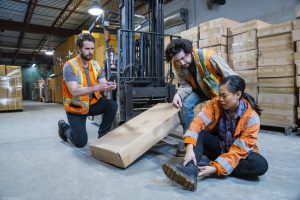 In Berks County, injured workers are generally limited to workers’ compensation benefits when their employer caused the injury. But workers’ comp has real limits, which we cover in the next section. When the injury was caused by a defect in the equipment itself rather than employer negligence, the injured worker may have a separate product liability claim against the manufacturer, distributor, or seller of that equipment.
Under Pennsylvania’s strict liability law, a manufacturer can be held liable without the injured person having to prove the manufacturer was careless. You only need to show three things: the product was defective, the defect made it unreasonably dangerous, and the defect caused your injury.
In practical terms, that means a forklift with faulty brakes, a defective overhead guard, a bad load indicator, or a design prone to tipping can give rise to a manufacturer liability claim. If the defect caused your injury, the manufacturer may be liable for your full damages, including categories that workers’ comp does not cover.
Workers’ Compensation and Product Liability: How the Two Claims Work Together
If you are hurt by defective equipment at work, you will almost certainly have a workers’ compensation claim. Workers’ comp is a no-fault system, which means you don’t have to prove your employer did anything wrong to receive benefits. In most cases, it is the right first step. Benefits kick in quickly and cover medical treatment and a portion of your lost wages while you recover.
The limitation is in what workers’ comp does not pay. It does not compensate for pain and suffering. It replaces only a portion of your wages, not your full income. It does not account for permanent disability beyond a set formula, and it does not cover future lost earning capacity the way a civil lawsuit can.
When your injury involves defective equipment, a product liability claim runs alongside your workers’ compensation claim, not instead of it. You are not choosing one or the other. Workers’ comp provides immediate support as your recovery progresses. A product liability claim against the manufacturer, distributor, or seller of the defective equipment seeks the full range of damages that workers’ comp leaves on the table.
Munley Law’s workers’ compensation team is led by Caroline Munley, a Pennsylvania Bar Association certified workers’ compensation specialist. That certification requires documented case experience, peer recognition, and a written examination, and is held by a small number of attorneys in Pennsylvania. Her team handles workers’ comp while Munley’s product liability attorneys pursue the third-party claim, so injured workers don’t have to navigate both tracks on their own.
Types of Equipment Defects That Cause Warehouse Injuries in Reading
Product liability claims in Berks County warehouse cases typically involve one of three types of defects.
A design defect means the product was dangerous because of its design, not because something went wrong during manufacturing. Every unit built to that design shares the same flaw. A forklift engineered with a center of gravity that makes it prone to tipping under normal load conditions is one example.
A manufacturing defect means the design was sound, but something went wrong during production. A specific unit or batch left the factory in a condition it was never supposed to be in. A brake component installed incorrectly, a weld that didn’t hold, a sensor that failed quality control.
A failure-to-warn defect means the manufacturer knew the equipment posed risks that weren’t obvious to a user but failed to provide adequate warnings or instructions. In warehouse settings, this can include missing warnings about load capacity limits, tipping hazards at certain speeds, or safe operating distances around pedestrians.
These three categories cover more equipment than most injured workers realize. Conveyor systems, pallet racking, dock levelers, and powered pallet jacks with defective controls can all give rise to third-party product liability claims when a defect caused the injury, not just forklifts.
Contact Our Reading Personal Injury Lawyers at Munley Law for a Free Consultation
If you were hurt by defective equipment at Amazon Muhlenberg, an I-78 distribution center, or another Berks County facility, you may have more options than a workers’ compensation claim alone. A product liability claim against the equipment manufacturer can recover damages that workers’ comp does not pay, including pain and suffering, full lost wages, and future earning capacity.
If you were injured by warehouse equipment in Berks County, contact Munley Law for a free consultation. There is no fee unless we win your case.

Caroline Munley
Caroline Munley is an experienced and award-winning personal injury lawyer and is a board-certified workers’ compensation specialist. Since 2018, she’s been listed in Best Lawyers in America (Personal Injury Plaintiffs; Workers’ Compensation Claimants, Northeastern PA), Lawdragon, and has been a Pennsylvania Super Lawyer since 2022. A member of the International Society of Barristers, Caroline has won millions of dollars for car accident, commercial truck crash, and workplace injury victims.
 Call us at (844) 686-5397
 Posted in Product Liability & Recalls.