Are Roundabouts Safer Than Traditional Intersections in the Lehigh Valley?
Across Pennsylvania, traffic planners have increasingly replaced traditional intersections with roundabouts, including on Route 222 in Lehigh County. These circular intersections are designed to improve traffic flow, reduce traffic backups, and improve road safety. However, when drivers misunderstand right-of-way rules or fail to yield, collisions can occur.
If you were injured in a roundabout crash in the Lehigh Valley, Munley Law’s award-winning attorneys can review your case and help you understand your rights under Pennsylvania law. Contact us today for a free consultation with an Allentown car accident lawyer.
 Call Us At 844-686-5397
 How Do Roundabouts Work?
A roundabout is a circular intersection where vehicles travel counterclockwise around a central island. Drivers entering the roundabout must yield to traffic already circulating inside it. 
Unlike traditional intersections controlled by traffic lights or stop signs, roundabouts rely on continuous movement. Vehicles enter when there is a safe gap in traffic rather than waiting for a signal.
Roundabouts are designed to reduce the number of conflict points between vehicles. At a typical four-way intersection, drivers may encounter dozens of potential crossing or turning conflicts. In a roundabout, these conflict points are significantly reduced because traffic moves in the same direction.

“At Munley Law, our mission is simple: to provide all injury victims equal access to justice, even against the most powerful entities. For almost 70 years, we have been the voice for the injured, the forgotten, and those who need someone to stand beside them in their darkest hour.”
Marion Munley

The Safety Benefits of Roundabouts
Studies from transportation agencies consistently show that roundabouts reduce the severity of crashes compared with traditional intersections. Because of this, city officials in Allentown are considering changes to road layouts as part of broader safety improvements.
Among the proposed solutions for high-risk intersections are the introduction of roundabouts. Concept plans include potential roundabouts along Hamilton Street between Ott and 19th streets, as well as at the busy intersection of Union Boulevard, Airport Road, and Irving Street.
Why Roundabouts Tend to Cause Fewer Crashes
Roundabouts reduce the number of situations where vehicles can collide. At a traditional four-way intersection, drivers may travel straight, turn left, or turn right across multiple lanes of traffic. These crossing movements create many potential conflict points where vehicles can collide.
In a roundabout, traffic moves in a single direction around a central island. Drivers entering the circle must yield to vehicles already inside it, which simplifies traffic patterns and reduces unpredictable crossing movements. Because vehicles are merging into the flow of traffic rather than crossing it, there are fewer opportunities for serious collisions.
Roundabouts also encourage slower driving. The curved entry lanes and circular design naturally force drivers to reduce speed before entering the intersection. Slower speeds make it easier for drivers to react to other vehicles, cyclists, and pedestrians.
For these reasons, roundabouts often result in fewer overall crashes compared with traditional signalized intersections.
Why Roundabout Crashes Are Usually Less Severe
Even when accidents occur in roundabouts, they tend to be less serious than crashes at traditional intersections.
At a typical traffic-light intersection, vehicles often approach from opposite directions at higher speeds. This can lead to dangerous “right-angle” or T-bone crashes, which frequently cause severe injuries because the side of a vehicle offers less protection than the front or rear.
Roundabouts largely eliminate these types of collisions. Because traffic moves in the same direction around the circle, most crashes involve vehicles traveling at similar speeds. Instead of high-impact crossing crashes, roundabout accidents are more likely to be low-speed sideswipes or minor rear-end collisions.
The slower speeds required to enter and navigate the roundabout also reduce the force of impact in the event of a crash. Lower-speed collisions generally lead to less severe vehicle damage and fewer serious injuries.
Common Causes of Roundabout Accidents in Allentown
Even though roundabouts are designed to improve safety, accidents still occur for several reasons. These are the most common causes of roundabout accidents:
Failure to Yield
The most common cause of a roundabout crash is a driver entering without yielding to vehicles already in the circle. Because circulating vehicles have the right of way, entering drivers must wait until it is safe to merge.
Improper Lane Use
Many modern roundabouts have multiple lanes. Drivers must choose the correct lane before entering, depending on where they intend to exit. Changing lanes inside the roundabout or drifting into another lane can cause sideswipe accidents.
Distracted Driving
Drivers who are looking at their phones, GPS devices, or passengers may fail to notice approaching traffic or pedestrians. Because roundabouts require quick decisions when entering, even brief distractions can lead to collisions.
Speeding Through the Roundabout
Roundabouts are designed to slow vehicles down. Drivers who enter too quickly may lose control or fail to yield properly.
Failure to Signal When Exiting
While not always required by law, signaling when exiting a roundabout helps other drivers anticipate traffic movements. Without clear signals, other vehicles may enter too soon, leading to a crash.
Who Is at Fault in a Roundabout Accident in Pennsylvania?
Determining who is at fault in a roundabout accident in PA often depends on right-of-way rules and the specific actions of each driver. 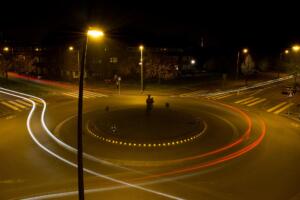
In many cases, the driver entering the roundabout is responsible if they fail to yield to vehicles already circulating. However, fault is not always so simple. Liability may depend on several factors, including:
- Whether a driver failed to yield when entering
- Improper lane changes within the roundabout
- Speeding or aggressive driving
- Distracted driving
- Failure to obey posted signs or lane markings
Pennsylvania follows a modified comparative negligence rule. This means more than one driver can share responsibility for a crash. If an injured person is found partially at fault, their compensation may be reduced by their percentage of fault.
Evidence such as police reports, witness statements, traffic camera footage, and vehicle damage patterns can help determine exactly how the crash occurred.
Roundabout Accidents in Allentown Involving Pedestrians and Cyclists
Roundabouts are often considered safer for pedestrians because vehicles travel at lower speeds. Many designs include pedestrian crossings set back from the roundabout entrance, giving drivers more time to see people crossing the road.
However, accidents involving pedestrians and cyclists can still occur when drivers fail to yield at crosswalks or are distracted while entering or exiting the roundabout.
Bicyclists may also face risks when navigating multi-lane roundabouts, particularly if drivers attempt to pass them too closely or fail to notice them in traffic.
Talk to a Lawyer After a Roundabout Accident in Allentown
Even though roundabouts are designed to improve safety, crashes can still happen when drivers fail to yield, misuse lanes, or enter the circle too quickly. Determining fault in these collisions is not always straightforward, particularly when multiple vehicles are entering and exiting the roundabout at the same time.
If you were injured in a roundabout accident in Allentown, understanding your legal options can be an important next step. A lawyer can review police reports, traffic patterns, witness statements, and other evidence to determine how the crash occurred and who may be responsible.
Munley Law has nearly seven decades of experience investigating complex traffic accidents throughout Pennsylvania, including collisions at intersections and on newer roadway designs such as roundabouts. Our Allentown team works with accident reconstruction specialists and other experts to help determine how a crash happened and what evidence may support an injury claim.
If you have questions about your rights after a roundabout crash, speaking with an Allentown intersection accident lawyer can help you better understand the next steps and whether you may be entitled to compensation. Contact us today for a free consultation.
Marion Munley
Marion Munley has been practicing personal injury law for nearly 40 years. She is triple board-certified by the National Board of Trial Advocacy for Truck Accident Law, Civil Trial Law, and Civil Practice Advocacy. She currently serves as Vice President of the American Association for Justice, an organization dedicated to safeguarding victims’ rights. Marion has won many multimillion-dollar recoveries for her clients, including one of the largest trucking accident settlements in history. She has been named a Top 10 Super Lawyer in Pennsylvania since 2023, a Best Lawyer in America, and was recently inducted to the Lawdragon Hall of Fame.
Munley Law Allentown
609 Hamilton St.
Allentown, PA 18101
(610) 857-7424
Posted in Car Accidents.