What You Should Know About Truck Accidents on Route 17 and I-81 Interchange Near Binghamton
The interchange where NY Route 17 meets Interstate 81 near downtown Binghamton is one of the most crash-prone stretches of highway in New York’s Southern Tier. Commercial trucks navigating this junction face compressed merge zones, sharp ramp curves, and heavy freight traffic year-round.
When a tractor-trailer is involved in a crash here, the injuries are often catastrophic, and determining liability requires applying both federal trucking regulations and New York state law. If you are injured in a truck crash in Binghmaton, we’re here to help. Contact the Binghamton truck accident lawyers at Munley Law today to schedule a free consultation.
Why Does the Route 17 and I-81 Interchange See So Many Truck Accidents?
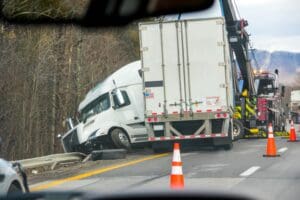 Binghamton sits where Interstate 81, Interstate 88, and Route 17 converge, making it a major freight junction for the entire Southern Tier. The Route 17/I-81 interchange presents specific physical hazards for large trucks: short acceleration and deceleration ramps, curve geometry that challenges trailer stability, and high passenger vehicle speeds mixing with slower commercial trucks. Winter conditions further reduce stopping distances for vehicles that already require far more braking distance than passenger cars.
The convergence of three major interstate routes makes Binghamton one of the highest-volume freight corridors in upstate New York, with interchange merge zones consistently among the most dangerous segments for large vehicle crashes.
How Serious Are Truck Crashes in New York State?
Large truck crashes cause harm well out of proportion to their share of traffic. In New York, large truck fatal and personal injury crashes reached 4,179 in 2022, with 126 people killed — 11 percent of all traffic fatalities that year, according to the Institute for Traffic Safety Management & Research (ITSMR) Large Truck Fact Sheet. That was the highest large truck fatality count in New York in five years. Those crashes follow a consistent pattern: according to the same ITSMR data, 88 percent of large truck fatal and personal injury crashes in New York occur on weekdays, and 77 percent happen between 6:00 a.m. and 6:00 p.m. — the same hours when commercial freight moves heaviest through the Binghamton interchange.
Tractor-trailers can weigh up to 80,000 pounds fully loaded. In a crash with a passenger vehicle, the smaller vehicle absorbs the overwhelming share of the force. Rollover crashes, underride collisions, and jackknife crashes — all more likely near tight interchange geometry — produce some of the highest injury severity rates in highway safety data.
How Do FMCSA Violations Create Liability After a Truck Accident?
Most freight moving through the Binghamton interchange crosses state lines, placing it squarely under federal jurisdiction. The Federal Motor Carrier Safety Administration (FMCSA) sets binding standards for driver conduct, vehicle maintenance, and carrier operations. A violation of any FMCSA rule is direct evidence of negligence — and each regulation corresponds to a specific liability exposure:
- Hours of Service (49 CFR Part 395): Drivers may not exceed 11 hours of driving within a 14-hour window, and must take 10 consecutive off-duty hours before resuming. ELD records showing HOS overages are among the strongest evidence of fatigue-related negligence.
- ELD requirements (49 CFR Part 395 Subpart B): Electronic logging devices must be tamper-resistant. If a carrier altered or failed to preserve log data after a crash, that spoliation can support punitive damages claims.
- Inspection, repair, and maintenance (49 CFR Part 396): Carriers must conduct pre- and post-trip inspections and maintain documented maintenance programs. Brake defects and tire failures are frequently traceable to skipped or falsified inspection records.
- Driver qualifications (49 CFR Part 391): Carriers must verify valid CDLs, current medical certification, and no disqualifying violations. Hiring or retaining an unqualified driver exposes the company to direct negligence liability.
- Cargo securement (49 CFR Part 393): Federal standards govern load securement and axle weight distribution. Improperly loaded trailers shift weight during braking and cornering, especially dangerous on interchange ramps, creating liability for the carrier and potentially the shipper.
How Does New York’s Comparative Negligence Law Affect Your Claim?
New York follows pure comparative negligence under CPLR Section 1411. Even if you were partially at fault, you can still recover damages, reduced only by your percentage of fault. A finding of 20 percent fault on a $500,000 claim still yields $400,000 in recovery. Trucking company insurers routinely try to shift fault to injured drivers to reduce payouts; an experienced attorney is essential to counter that strategy.
New York’s no-fault system covers immediate medical costs regardless of fault, but pain and suffering claims require a “serious injury,” including significant fractures, permanent limitations, or disability lasting 90 days or more. Truck accident injuries regularly meet that threshold.
What Should You Do After a Truck Accident Near the Binghamton Interchange?
Evidence in truck crash cases disappears fast — ELD logs get overwritten, cameras get cleared, and trucking companies deploy claims teams immediately. Take these steps:
- Get medical attention right away, even if you feel OK — adrenaline masks pain and early documentation matters.
- Call 911. A state police or Binghamton police report creates an official crash record.
- Photograph everything: skid marks, vehicle positions, cargo, signage, and road conditions before the scene is cleared.
- Get witness information. Bystanders and other drivers may have seen what caused the crash.
- Contact an attorney before talking to the trucking company’s insurer. Recorded statements without legal counsel can be used to reduce your recovery.
Contact Our Binghamton Truck Accident Lawyers at Munley Law
If you or a family member was injured in a truck accident near the Route 17 and I-81 interchange, Munley Law is ready to help. Our attorneys understand FMCSA regulations and New York truck accident law, and we know how to investigate commercial crashes, preserve critical evidence, and take on trucking company insurers. We have served Binghamton and the Southern Tier for over 65 years. There are no attorney fees unless we win your case.

Marion Munley
Marion Munley has been practicing personal injury law for nearly 40 years. She is triple board-certified by the National Board of Trial Advocacy for Truck Accident Law, Civil Trial Law, and Civil Practice Advocacy. She currently serves as Vice President of the American Association for Justice, an organization dedicated to safeguarding victims’ rights. Marion has won many multimillion-dollar recoveries for her clients, including one of the largest trucking accident settlements in history. She has been named a Top 10 Super Lawyer in Pennsylvania since 2023, a Best Lawyer in America, and was recently inducted to the Lawdragon Hall of Fame.
 Call us at (844) 686-5397
 Posted in Truck Accidents.