Pedestrian Accidents in Downtown Reading: Crosswalk Laws and Municipal Liability in PA
Downtown Reading draws steady foot traffic to Penn Street, the GoggleWorks arts district, the Sovereign Center area, and the surrounding blocks of Berks County’s most densely populated city. For pedestrians crossing those intersections every day, a moment of driver inattention can mean a life-altering injury.
Pedestrian crashes in Berks County are not isolated events. According to the Berks County RATS Safety Report, reported pedestrian accidents increased 25% between 2021 and 2024, rising from 122 to 153 across the county. Downtown Reading accounts for a significant share of those numbers. For a broader look at what PennDOT crash data reveals about injury patterns across Berks County, including pedestrian, bicycle, and vehicle crashes, see our analysis of Reading accidents trend.
If you were struck by a vehicle in a downtown Reading crosswalk, or if a dangerous sidewalk or intersection condition contributed to your injury, Pennsylvania law may give you a path to compensation. Understanding who can be held responsible — a private driver, the City of Reading, or both — is the first step.
What Are Pennsylvania’s Crosswalk Laws?
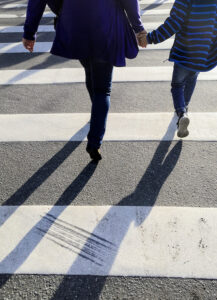 Pennsylvania’s Vehicle Code establishes clear rules for drivers and pedestrians at crosswalks. Under 75 Pa.C.S. § 3542(a), when traffic signals are not in place or not operating, every driver must yield the right-of-way to pedestrians crossing within any marked crosswalk or within any unmarked crosswalk at an intersection.
That last point matters in downtown Reading. An unmarked crosswalk — the implied extension of a sidewalk across an intersection, even without painted lines — carries the same legal weight as a painted one under Pennsylvania law. Drivers cannot claim they were unaware of a pedestrian’s right-of-way simply because no stripes were visible on the pavement.
The law also protects pedestrians in multi-lane situations. Under § 3542(c), if one vehicle stops at a crosswalk to let a pedestrian cross, drivers in adjacent lanes cannot pass that stopped vehicle. This rule is specifically designed to prevent what traffic safety researchers call “multiple threat crashes” — a significant risk on Penn Street and other downtown corridors with multiple travel lanes.
Pedestrians have responsibilities too. Section 3542(b) prohibits suddenly leaving the curb and stepping into the path of a vehicle that is already too close to stop safely. Pennsylvania comparative negligence rules — found at 42 Pa.C.S. § 7102 — mean that a pedestrian’s partial fault reduces, but does not bar, their recovery as long as their share of fault does not exceed 50%.
 Call Us At 844-686-5397
 Can You Sue the City of Reading for a Dangerous Crosswalk or Sidewalk?
This is where many pedestrian accident claims become more complicated, and where many injured people don’t realize they may have a second avenue of recovery.
Pennsylvania municipalities generally enjoy governmental immunity under 42 Pa.C.S. § 8541. The City of Reading cannot be sued simply because a pedestrian was hurt on its streets. However, the Political Subdivision Tort Claims Act carves out specific exceptions to that immunity under 42 Pa.C.S. § 8542.
Two exceptions apply directly to pedestrian accident scenarios in downtown Reading:
- The streets exception — § 8542(b)(6): A municipality can be held liable for a dangerous condition of streets it owns, provided the claimant can establish that the condition created a reasonably foreseeable risk of the kind of injury suffered, and that the City had actual notice — or reasonably should have known — of the condition in time to fix it. Examples relevant to pedestrian crosswalk accidents include faded or missing crosswalk markings, malfunctioning pedestrian signals, inadequate lighting at marked crossings, or intersection configurations that create blind spots.
- The sidewalk exception — § 8542(b)(7): A municipality can also be liable for dangerous conditions on sidewalks within the rights-of-way of streets it owns. Broken curb ramps, raised pavement, uneven surfaces near crosswalks, and missing ADA-compliant tactile warning strips all potentially fall within this exception — again, subject to the notice requirement.
In both cases, proving that the City had notice of the problem before the injury is essential. This often means gathering prior 311 complaint records, Public Works maintenance logs, prior incident reports, or documentation of neighborhood complaints about the same location.
What Is the Six-Month Notice Deadline — And Why Does It Matter?
If you are pursuing a claim against the City of Reading or any other local government agency, Pennsylvania law imposes a strict procedural requirement on top of the standard two-year personal injury statute of limitations.
Under 42 Pa.C.S. § 5522, you must file written notice of your claim with the municipality within six months of the date of injury. That written notice must include your name and address, the date, time, and location of the accident, and the name and address of your treating physician.
Missing this deadline does not just weaken your case — in most circumstances, it ends it entirely. Many injured pedestrians in Reading focus on their medical recovery in the months after an accident, unaware that a government claims deadline is running out. The two-year personal injury limitations period does not replace this requirement; both must be met independently.
Damages in a claim against a local agency are capped at $500,000 per claimant under 42 Pa.C.S. § 8553. Claims against private drivers are governed by standard Pennsylvania tort law with no statutory cap.
Munley Law’s Reading Office Is Here to Help
If you were injured in a pedestrian accident in downtown Reading or anywhere in Berks County, contact the pedestrian accident lawyers at Munley Law. Our personal injury attorneys offer free consultations and handle all cases on a contingency basis — no fee unless we win.
Munley Law Personal Injury Attorneys
606 Court St., Reading, PA 19601
(610) 831-4234

Marion Munley
Marion Munley has been practicing personal injury law for nearly 40 years. She is triple board-certified by the National Board of Trial Advocacy for Truck Accident Law, Civil Trial Law, and Civil Practice Advocacy. She currently serves as Vice President of the American Association for Justice, an organization dedicated to safeguarding victims’ rights. Marion has won many multimillion-dollar recoveries for her clients, including one of the largest trucking accident settlements in history. She has been named a Top 10 Super Lawyer in Pennsylvania since 2023, a Best Lawyer in America, and was recently inducted to the Lawdragon Hall of Fame.
Posted in Pedestrian Accidents.