




A workplace injury changes everything quickly. You are dealing with pain, medical appointments, and uncertainty about your job. At the same time, you may be hearing from your employer’s insurance company before you have had a chance to speak with anyone on your side. Understanding your legal rights from the start is not optional. It is the difference between receiving everything the law entitles you to and settling for far less.
The Pennsylvania Workers’ Compensation Act gives injured workers a defined set of legal rights. These rights do not depend on your employer’s generosity or your insurance carrier’s cooperation. They are statutory rights, written into Pennsylvania law, and they apply from the moment your injury happens.
What Does the Pennsylvania Workers’ Compensation Act Cover?
The Pennsylvania Workers’ Compensation Act is the state law that governs what happens when a worker is injured on the job. It applies to nearly every employee in Pennsylvania, including full-time, part-time, and seasonal workers. Independent contractors generally are not, though misclassification is common and worth examining if you were injured while doing work that looks and functions like employment.
The Act covers injuries that happen while you are performing your job duties, as well as occupational diseases, which are conditions that develop over time as a result of workplace exposure, such as respiratory disease from chemical inhalation or repetitive stress injuries from repeated physical tasks. The injury does not have to happen at a fixed location. Workers injured while driving for work, making deliveries, or working off-site may still have a valid claim.
How Long Do You Have to Report a Workplace Injury in Pennsylvania?
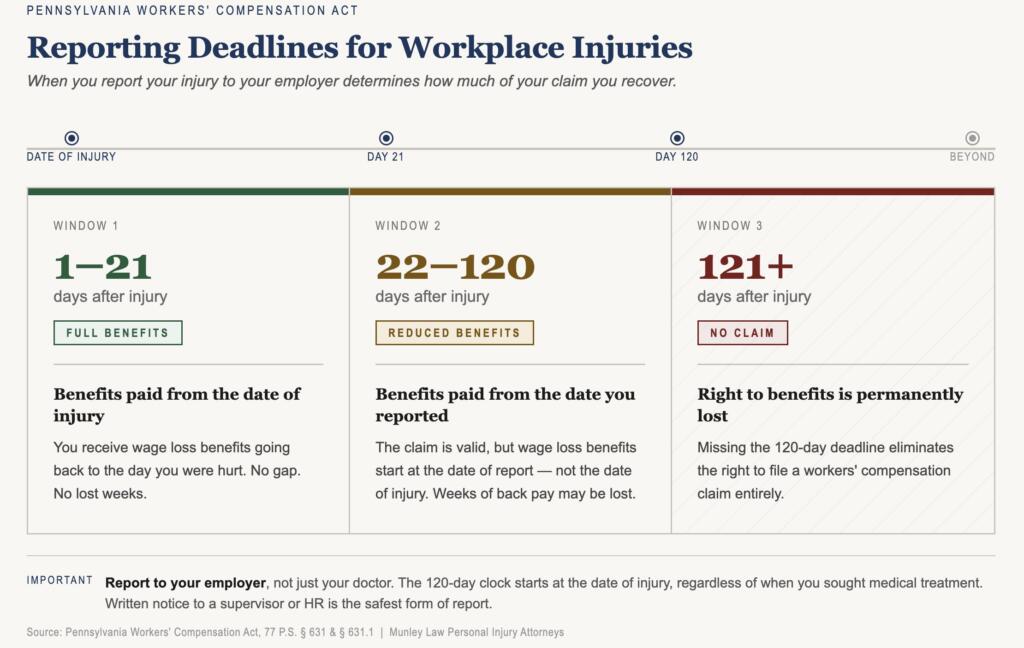
Pennsylvania law requires injured workers to report the injury to their employer within 120 days of when it happened. Missing that deadline means losing the right to claim workers’ compensation benefits entirely.
Reporting within 21 days matters for a different reason. If you report within 21 days of the injury, your wage loss benefits are calculated from the date the injury occurred. If you wait longer than 21 days but still report within the 120-day window, your benefits are calculated from the date you reported, not the date of injury. That gap can mean weeks of benefits you do not recover.
Report the injury to your employer or supervisor in writing whenever possible. Keep a copy. Document the date, what happened, and who you told. This protects you if your employer later disputes when they were notified.
Contact a Workers’ Compensation Attorney at Munley Law
 Call Us At 844-686-5397
 What Medical Treatment Are You Entitled to After a Work Injury?
 Under the Pennsylvania Workers’ Compensation Act, your employer’s insurance carrier is required to pay for all medical treatment that is reasonable and necessary to treat your work injury. There is no time limit on this obligation and no dollar cap. If you need treatment, it must be covered.
The one significant limitation involves the 90-day panel rule. If your employer posted a list of designated health care providers (a panel) in the workplace, you are required to treat within that panel for the first 90 days after your injury. After 90 days, or if no valid panel was posted, you have the right to treat with any licensed health care provider of your choosing.
Employers sometimes fail to post the required panel properly or post panels that do not meet the legal requirements. If the panel was not valid, the 90-day restriction does not apply. A workers’ compensation attorney can verify whether the panel your employer presented meets the standards set under Pennsylvania law.
What Wage Benefits Can You Claim While You Cannot Work?
Pennsylvania workers’ compensation pays wage loss benefits equal to approximately two-thirds of your average weekly wage, subject to a maximum set by the state each year. The benefit amount is calculated based on your earnings in the year before the injury.
The type of benefit depends on your ability to return to work. Total disability benefits apply when you cannot work at all. Partial disability benefits apply when you can work in some capacity but are earning less than you were before the injury. Benefits for permanent loss of a body part, such as a hand, finger, leg, or eye, are calculated separately under specific loss provisions in the Act.
What Happens if Your Employer Does Not Accept Your Claim?
After a work injury is reported, your employer’s insurance carrier has 21 days from the start of your disability to either accept your claim or deny it. If the claim is accepted, they will issue a Notice of Compensation Payable and begin paying benefits. If the claim is disputed, they will issue a Notice of Compensation Denial.
A denial is not the end of your claim. You have the right to file a Claim Petition with the Pennsylvania Workers’ Compensation Appeal Board, which will assign your case to a Workers’ Compensation Judge (WCJ) for a hearing. The WCJ will review the evidence and issue a decision. From there, the appeals process runs from the WCJ to the Workers’ Compensation Appeal Board, then to the Commonwealth Court of Pennsylvania, and in limited circumstances to the Pennsylvania Supreme Court.
Insurance carriers count on injured workers not knowing how to respond to a denial. Having an attorney file and present your Claim Petition significantly changes the outcome in a large percentage of contested cases.
Can Your Employer Retaliate Against You for Filing a Workers’ Compensation Claim?
No. Section 301a of the Pennsylvania Workers’ Compensation Act prohibits employers from discharging or threatening to discharge a worker for filing, or being about to file, a workers’ compensation claim. If your employer fires you, demotes you, cuts your hours, or otherwise penalizes you in direct response to your claim, that is a violation of state law.
Pennsylvania is an at-will employment state, which means employers can generally terminate workers for any lawful reason. Filing a workers’ compensation claim is one of the reasons that is specifically illegal. Proving retaliation requires showing that the adverse action was connected to the claim. Timing, supervisor comments, and departure from normal procedures all become relevant evidence.
What Is Your Employer Required to Do After a Workplace Injury?
The Pennsylvania Workers’ Compensation Act places specific legal obligations on employers, not just rights on workers. Knowing what your employer is required to do helps you identify when those obligations are not being met.
Under Pennsylvania law, your employer must:
- Carry workers’ compensation insurance. Every Pennsylvania employer with at least one employee is required by law to carry WC coverage or be approved as a self-insurer. There are no exceptions for small businesses.
- Post a Notice of Workers’ Compensation Agent in a visible location in the workplace. This notice identifies the insurance carrier and includes the panel of health care providers, if one exists.
- Report the injury to their insurance carrier promptly. For fatal accidents, the report must be filed with the Pennsylvania Bureau of Workers’ Compensation within 48 hours. For non-fatal injuries causing lost work time, the report must be filed within seven days.
- Accept or formally deny your claim within 21 days of the start of your disability. Silence or delay is not a valid response under Pennsylvania law.
- Not retaliate against you for filing a claim, as described above.
What If Your Employer Does Not Have Workers’ Compensation Insurance?
Some employers in Pennsylvania operate without required workers’ compensation coverage. If you are injured while working for an uninsured employer, you are not left without recourse.
Pennsylvania maintains the Uninsured Employers Guaranty Fund (UEGF), which exists specifically to pay workers’ compensation claims when employers fail to carry the required coverage. You can file a claim with the UEGF the same way you would file against an insured employer’s carrier. The UEGF then pursues reimbursement directly from the employer.
Operating without workers’ compensation insurance is a criminal offense in Pennsylvania. An uninsured employer faces civil penalties and potential criminal prosecution in addition to liability for your claim. The absence of insurance does not reduce what you are entitled to recover. It changes who pays it.
Why Should You Hire a Workers’ Compensation Lawyer?
 From the moment a workplace injury is reported, your employer’s insurance carrier begins building its file. They have adjusters, nurse case managers, and defense attorneys who handle claims every day. You are entitled to the same level of representation.
A workers’ compensation attorney can verify that your benefits are being calculated correctly, challenge a claim denial, represent you before a Workers’ Compensation Judge, and identify whether a third party, such as a negligent equipment manufacturer, a property owner, or another driver, shares liability for your injury in addition to the WC claim.
Munley Law handles workers’ compensation cases on a contingency fee basis. There is no fee unless we recover compensation for you. That means you can speak with an attorney about your rights without any upfront cost.
Why Do Injured Pennsylvania Workers Choose Munley Law?
Munley Law has represented injured workers across Pennsylvania for more than 65 years. The firm’s workers’ compensation practice is led by Caroline Munley, who holds certification as a workers’ compensation specialist from the Pennsylvania Bar Association, one of a limited number of attorneys in the state to hold that credential.
That specialization reflects years of practice exclusively in this area of law. Workers’ compensation cases involve specific procedural rules, strict deadlines, and an insurance system that is designed to limit payouts. J. Christopher Munley has been recognized as Lawyer of the Year for Workers’ Compensation in Pennsylvania by Best Lawyers, the peer-review publication that evaluates attorneys based on confidential feedback from fellow practitioners in the field.
The attorneys at Munley Law are members of the American Association for Justice and hold the highest peer ratings available through Martindale-Hubbell. The firm has recovered more than $1 billion in total compensation for clients across Pennsylvania. If you were injured at work, call Munley Law for a free consultation. We are available 24 hours a day, seven days a week.

Caroline Munley
Caroline Munley is an experienced and award-winning personal injury lawyer and is a board-certified workers’ compensation specialist. Since 2018, she’s been listed in Best Lawyers in America (Personal Injury Plaintiffs; Workers’ Compensation Claimants, Northeastern PA), Lawdragon, and has been a Pennsylvania Super Lawyer since 2022. A member of the International Society of Barristers, Caroline has won millions of dollars for car accident, commercial truck crash, and workplace injury victims.