Pittsburgh Temp Workers’ Comp at Warehouses and Construction Sites: When the Staffing Agency and Host Employer Are Both Liable
If you were injured while working a temporary assignment at a Pittsburgh warehouse or construction site, you may be unsure who is responsible for your medical bills and lost wages—the staffing agency that placed you, the company where you were actually working, or both. The answer depends on a body of Pennsylvania law that governs the relationship between staffing agencies, host employers, and the workers they share.
The Pittsburgh workers’ compensation attorneys at Munley Law understand how these dual-employment arrangements are evaluated under Pennsylvania law and how liability is determined when something goes wrong.
Where Temp Workers Are Getting Hurt in the Pittsburgh Region
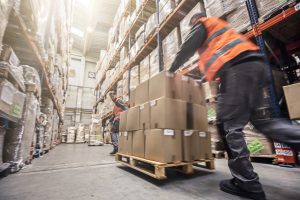 Warehouse and construction work across Allegheny County and the surrounding areas is concentrated in specific corridors. Large distribution hubs operate near the I-376 corridor through Findlay Township and Imperial, around Pittsburgh International Airport, and along Route 30 into Westmoreland County. Facilities like Amazon fulfillment centers have reshaped expectations for speed and output across the industry, and similar operational pressures exist at regional hubs serving Pittsburgh.
Construction activity continues across the North Shore, the Strip District, and Hazelwood Green, with additional projects spreading into Cranberry Township, Robinson Township, and Monroeville. Many of these sites rely on temporary labor to meet deadlines.
The injury risk in these sectors is not theoretical. According to OSHA data released in April 2025, transportation and warehousing reported 232,000 workplace injuries in 2024, second only to healthcare. Construction recorded the second-highest number of workplace fatalities nationally. In Pennsylvania, fatal work injuries totaled 185 in 2024, a 9.5% increase from 2023, according to the U.S. Bureau of Labor Statistics. The construction and material-moving sectors accounted for a significant share of those deaths.
Temporary workers face added exposure in these environments. Many are placed on active floors or job sites with limited site-specific training. They are often expected to match the pace of experienced workers immediately, whether that means keeping up with conveyor systems in a warehouse or navigating active equipment zones on a construction site. When an injury happens, uncertainty about reporting procedures can delay medical care and documentation.
How Dual Employment Works in Pittsburgh Temp Jobs
In most staffing arrangements, the agency that placed you is your employer on paper. It pays your wages and carries the workers’ compensation insurance policy that covers you. If you are injured on assignment, that is typically where the claim is filed.
The company where you are actually working controls the job itself. In a warehouse, the line speed, equipment use, and safety procedures are included. On a construction site, it includes task assignments, supervision, and coordination with other trades. That level of control is what determines whether the host company also takes on legal responsibility as a co-employer.
For injured workers, the immediate point is straightforward: workers’ compensation coverage applies from your first day on assignment. You do not need to determine fault before seeking benefits. The claim process begins with the staffing agency’s insurance coverage, even if the injury occurred under the host employer’s supervision.
When a Pittsburgh Host Employer Becomes Your Legal Employer Under Pennsylvania Law
Pennsylvania courts look closely at who controlled the work being performed. The standard comes from Mature v. Angelo, a Pennsylvania Supreme Court decision that focuses on who had the right to direct not just the result of the work, but how the work was done.
This issue comes up frequently in warehouse and construction cases across Western Pennsylvania. When a host employer has full control over a temp worker’s daily tasks, including the ability to direct, discipline, or remove them, courts may treat that company as a co-employer. That designation limits the injured worker to workers’ compensation benefits for claims against that company.
If that level of control is not present, the host employer may still be exposed to a negligence claim. The distinction often turns on the details of supervision and control on the job site, not just what the contract between companies says.
Claims involving Pittsburgh-area job sites are typically litigated through the Allegheny County Court of Common Pleas, with workers’ compensation matters handled through the Pennsylvania Workers’ Compensation Office of Adjudication.
Third-Party Liability on Pittsburgh Job Sites
Workers’ compensation does not cover every category of loss. It provides medical benefits and partial wage replacement, but it does not include damages like pain and suffering or full lost income. That is why identifying third-party liability matters in serious injury cases.
On Pittsburgh-area construction sites and warehouse operations, several types of third parties may be involved:
- General contractors and property owners. On multi-employer sites in areas like the Strip District or along the I-376 corridor, responsibility for site safety is often shared. Failures involving fall protection, scaffolding, or site coordination can create liability outside the workers’ compensation system.
- Equipment manufacturers. Forklifts, pallet jacks, conveyor systems, and cranes are common sources of injury in warehouse and construction settings. If a defect contributed to the incident, a product liability claim may exist regardless of the employment relationship.
- Other subcontractors. Large construction projects in Allegheny, Beaver, and Butler counties often involve multiple trades working simultaneously. If a worker from another company caused the injury, their employer may be a separate defendant.
These cases often run alongside a workers’ compensation claim. One does not cancel out the other, but the structure of the case depends on which parties are considered employers and which are not.
What Injured Temp Workers in Pittsburgh Should Do First
Confusion about reporting is one of the most common issues in temp worker injury cases.
Report the injury to both the staffing agency and the on-site supervisor as soon as possible, and do it in writing when you can. The agency needs notice to initiate the workers’ compensation claim. The host employer needs to document the incident at the site.
Seek medical care right away. In Pittsburgh, that often means treatment through UPMC or Allegheny Health Network facilities. Early records from emergency departments and follow-up providers become central evidence in the claim.
Do not rely on informal guidance from supervisors about whether to file a claim. Workers’ compensation in Pennsylvania is a no-fault system. Even if you think you contributed to the accident, that does not eliminate your right to benefits.
Representation Across Western Pennsylvania
Munley Law represents injured workers throughout Allegheny County and the surrounding region, including Westmoreland County, Beaver County, Butler County, and Washington County. Temporary workers injured at warehouses, distribution centers, and construction sites across these areas often face the same threshold issue: identifying who is legally responsible and which claims are available.
Sorting that out early affects every part of the case, from where the claim is filed to whether additional compensation may be available beyond workers’ compensation. Contact Munley Law if you’re seeking justice in a workers’ compensation case.

Caroline Munley
Caroline Munley is an experienced and award-winning personal injury lawyer and is a board-certified workers’ compensation specialist. Since 2018, she’s been listed in Best Lawyers in America (Personal Injury Plaintiffs; Workers’ Compensation Claimants, Northeastern PA), Lawdragon, and has been a Pennsylvania Super Lawyer since 2022. A member of the International Society of Barristers, Caroline has won millions of dollars for car accident, commercial truck crash, and workplace injury victims.
 Call us at (844) 686-5397
 Posted in Munley News.